


Examples of Integrated Learning for Kids Ages 1.5 to 12
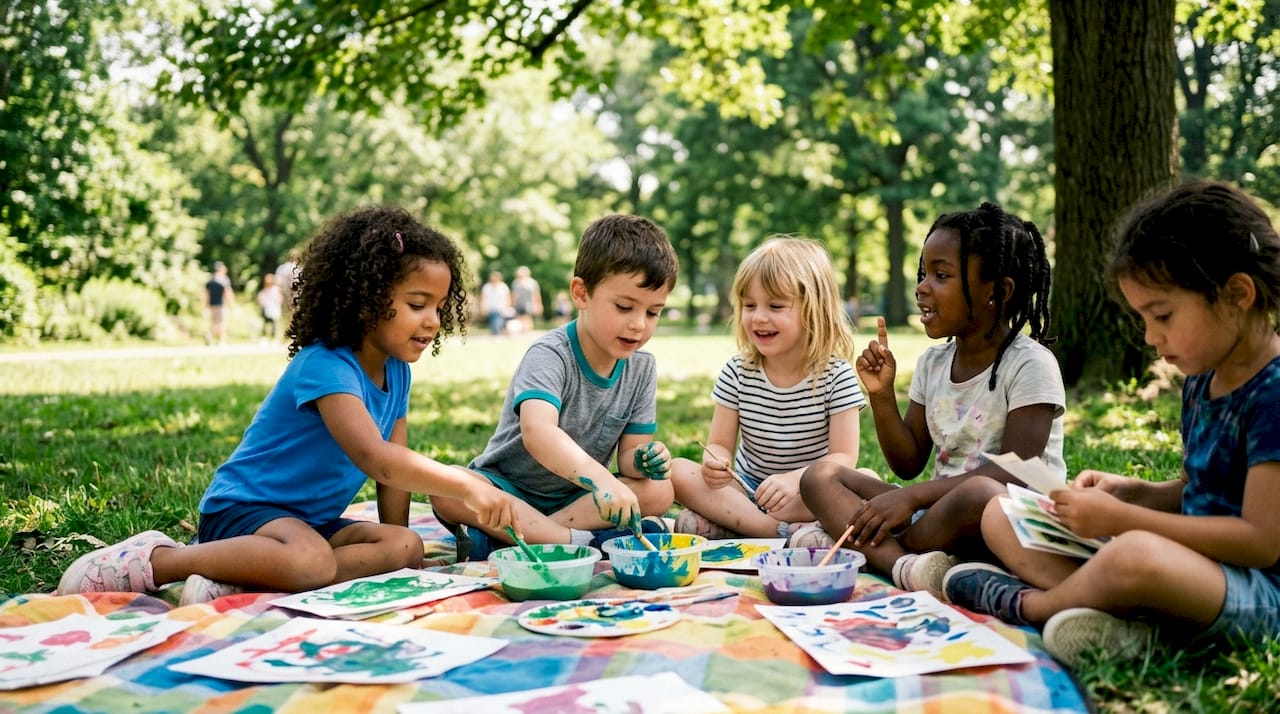
Integrated learning is defined as an educational approach that blends two or more subject areas around a shared theme, so children build connected understanding rather than isolated facts. A child studying “Water” might measure rainfall in math, read poems about rivers in language arts, and paint watercolor landscapes in art, all in the same week. These examples of integrated learning show how knowledge sticks when it feels real and relevant. Research confirms that students in active, integrated learning environments show significantly higher satisfaction and stronger academic results than peers in traditional classrooms.
1. What are examples of integrated learning in early childhood?
Integrated learning examples are thematic units and cross-subject activities that connect science, math, language arts, social studies, art, and movement around one central idea. The most widely used examples for young children include themes like “My Neighbourhood,” “Water,” “Food and Nutrition,” “Community,” and “Space.” Each theme becomes a lens through which children explore multiple disciplines at once. A “My Neighbourhood” unit for ages 1.5 to 6 might combine language and movement through role-play, simple map drawing, and neighborhood walks. The result is richer understanding than any single subject lesson could produce.
The formal term for this approach is integrated curriculum, sometimes called cross-curricular learning or thematic teaching. Both terms describe the same core idea: subjects are not taught in silos. When children see how math, reading, and science all connect to one real topic, they retain concepts longer and apply them more confidently.
2. What are thematic units and why do they work?
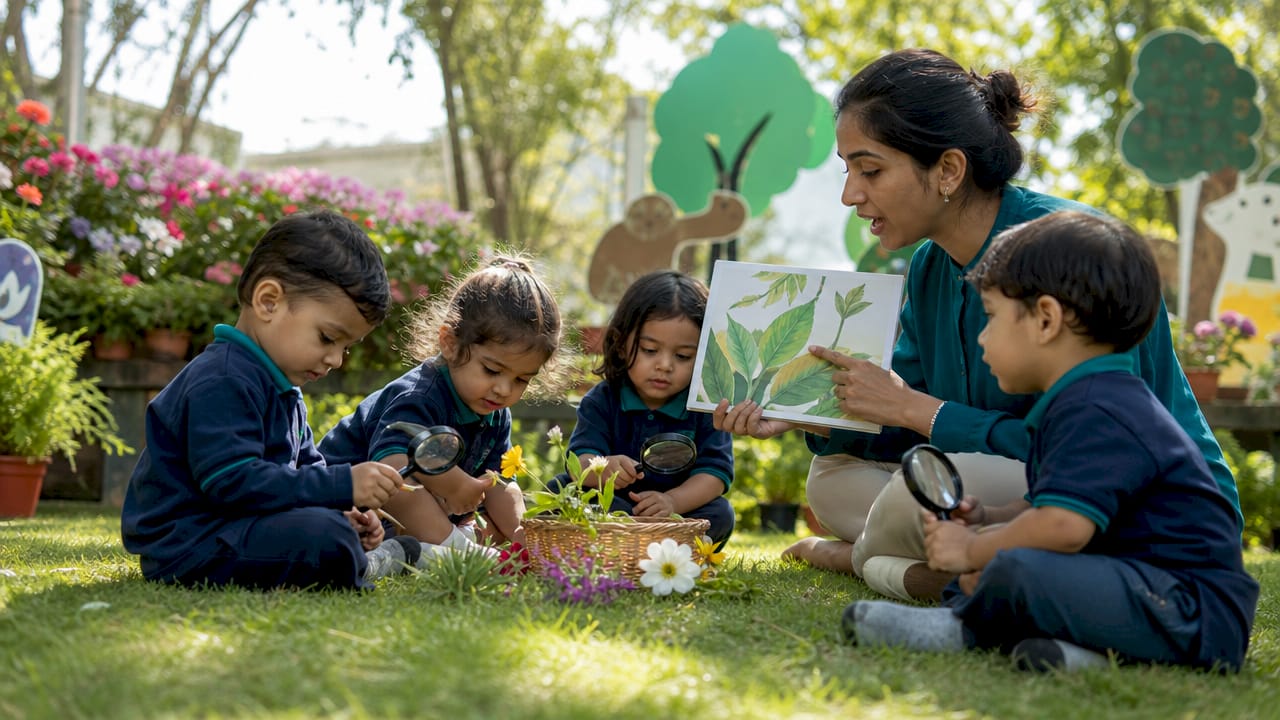
Thematic units are the most common structure for integrated curriculum examples in early childhood and primary education. A theme like “Water” pulls together science (the water cycle), geography (rivers and oceans), art (watercolor painting), literature (stories about the sea), and even physical education (swimming or water relay games). Children do not just memorize facts. They build a web of understanding around a single, meaningful topic.
Thematic units work because children’s brains naturally seek patterns and connections. When a child learns that water evaporates, writes a poem about rain, and measures a puddle shrinking over three days, three separate subjects reinforce the same concept. That repetition across contexts deepens memory and builds genuine curiosity.
Common thematic units used in schools include:
My Neighbourhood (ages 1.5 to 6): role-play, simple maps, community walks, counting houses
Water (ages 4 to 10): water cycle science, measurement math, conservation art projects, poetry
Food and Nutrition (ages 5 to 12): food diaries, fractions in recipes, cultural social studies, garden science
Community (ages 6 to 12): interviews, mapping, persuasive writing, history research
Space (ages 7 to 12): astronomy, scale and distance math, creative writing, engineering challenges
Pro Tip: Ask your child’s teacher which theme the class is currently exploring. Then reinforce it at home with a related book, a simple experiment, or a neighborhood observation walk. That home connection multiplies the school learning.
3. Integrated learning activities by age group
Practical examples of cross-curricular learning look different depending on a child’s age. The activities below are organized by developmental stage so you can recognize them in school and replicate them at home.
For toddlers and preschoolers (ages 1.5 to 6)
Neighborhood role-play: Children set up a pretend shop, post office, or café. They practice counting (math), reading signs (literacy), and social rules (social studies) all at once.
Simple map drawing: After a walk, children draw their route using shapes and colors. This combines spatial awareness, art, and early geography.
Sensory water play: Pouring, measuring, and describing water textures builds science vocabulary, math concepts, and language skills simultaneously.
Planting seeds: Observing growth over weeks connects science, measurement, journaling, and patience as a social-emotional skill.
For primary school children (ages 6 to 12)
Food diary project: Children track what they eat for a week, calculate portions (math), research food origins (social studies), and write a reflection (language arts).
Water conservation campaign: Students research local water use, create persuasive posters (language arts and art), and present data in charts (math).
Community interview project: Children interview a local professional, write up findings, and present to the class. This builds research skills, writing, and public speaking together.
Bridge-building challenge: Using craft materials, children design and test a bridge. They apply physics concepts, measurement, teamwork, and written documentation.
Weather station: Recording daily temperature and rainfall over a month connects data collection (math), climate science, and graph reading.
Outdoor learning amplifies many of these activities. When children measure a real garden bed or interview a real neighbor, the learning becomes memorable in a way a worksheet cannot replicate.
4. How integrated learning strategies improve outcomes
Integrated learning strategies produce measurably better results than traditional subject-by-subject teaching. A quasi-experimental study comparing 373 students in active, integrated learning environments with 365 students in traditional classrooms found satisfaction scores of 3.468 ± 0.067 versus significantly lower scores in the control group (p < 0.0001). Academic gains were strongest in graduate-level and medium to large class settings. That finding matters because it shows integration works across age groups, not just in early childhood.
“Integrated learning moves beyond memorization to real-world application, fostering essential skills like collaboration and critical thinking.”
The specific strategies that drive these results include:
Flipped classroom approaches: Children explore a concept at home through a video or activity, then apply it collaboratively in school.
Small-group project work: Mixed-ability groups tackle a shared problem, building communication and adaptability alongside subject knowledge.
Role-playing and simulation: Acting out historical events or scientific processes builds empathy, memory, and analytical thinking at the same time.
Active movement integration: Physical activity woven into lessons, such as measuring distances by walking or acting out the water cycle, improves focus and retention.
These strategies also benefit teachers. Integration reduces re-teaching by placing concepts in context from the start. Teachers spend less time reviewing forgotten material and more time building on what children already know. That shift improves teacher morale and instructional quality.
Pro Tip: When your child comes home from school, ask “What did you connect today?” instead of “What did you learn?” That question signals that linking ideas matters, and it encourages children to think across subjects naturally.
5. Types of integrated learning approaches compared
Not all integrated curriculum examples look the same. Schools use different levels of subject overlap depending on their resources, teacher training, and curriculum goals. Understanding these types helps you ask better questions when choosing a school.
Approach | How it works | Typical example | Best for |
Sequenced | Two subjects teach related topics at the same time but separately | Math teacher covers fractions while science teacher covers measurement | Ages 8 to 12, introductory integration |
Shared | Two teachers co-plan overlapping content | Language arts and social studies share a unit on community stories | Ages 6 to 12, collaborative schools |
Webbed (thematic) | One theme connects all subjects | “Water” unit spanning science, art, math, and literacy | Ages 1.5 to 12, most common in early years |
Threaded | Meta-skills like critical thinking are woven through all subjects | Every subject includes a research and presentation component | Ages 8 to 12, skill-focused schools |
Fully integrated | All subject boundaries dissolve into one project | A food unit where cooking, math, science, writing, and art are inseparable | Ages 5 to 12, project-based schools |
Types of integration range from light coordination between two teachers to full dissolution of subject boundaries. The webbed or thematic approach is the most accessible for parents to recognize and support at home. The fully integrated model, while the most demanding to plan, produces the deepest learning when done well.
6. How to implement integrated learning: practical steps
Implementing integrated learning does not require a complete curriculum overhaul. Small steps build toward meaningful integration over time. A structured six-stage model guides effective implementation: problem orientation, prior knowledge activation, disciplinary exploration, interdisciplinary connection, integrative production, and reflection. Skipping the early stages and jumping straight to projects leads to surface-level work that does not stick.
Practical steps for parents and educators include:
Start with a driving question: “How does our neighborhood get its food?” is more engaging than “Let’s study community helpers.” A good question pulls children across subjects naturally.
Use bridge activities: A shared writing prompt or a simple experiment can connect two subjects without restructuring the whole school day. Small bridge activities are a low-risk way to introduce integration.
Build in reflection time: Ask children to explain how two things they learned connect. That moment of reflection is where integration becomes understanding.
Use shared rubrics: Clear assessment rubrics across subjects reduce confusion for children and parents. Children know what success looks like, regardless of which subject is being assessed.
Embrace exploratory play: For children under 6, unstructured play with materials related to the theme (water, soil, building blocks) is a legitimate and powerful form of integrated learning.
Pro Tip: At home, try a “theme of the month.” Pick something your child loves, like dinosaurs or baking, and find the math, science, history, and art in it. You do not need a lesson plan. Curiosity does the work.
Key takeaways
Integrated learning is most effective when subjects connect around a meaningful theme, giving children real-world context that deepens understanding and builds lasting skills.
Point | Details |
Thematic units are the core model | Themes like “Water” or “Community” connect science, math, literacy, and art for richer learning. |
Age-appropriate activities matter | Toddlers benefit from role-play and sensory activities; primary children gain from projects and research tasks. |
Research backs the approach | Students in integrated active learning environments show significantly higher satisfaction and academic gains. |
Five integration types exist | From sequenced to fully integrated, each type offers a different depth of subject overlap and collaboration. |
Small steps work at home | A driving question or theme-based play at home reinforces school integration without needing a formal plan. |
Why I believe integrated learning is the most honest way to teach children
I have spent years watching children light up when they realize that the math they just did connects to the science experiment they ran yesterday. That moment of recognition, when a child says “Oh, it’s the same thing!”, is not a small thing. It is the foundation of genuine understanding.
What strikes me most is how rarely traditional schooling creates that moment on purpose. Subjects are kept separate as if knowledge itself is compartmentalized. But children do not experience the world that way. A child baking with a parent is doing fractions, chemistry, reading, and cultural history all at once, without anyone calling it a lesson.
The research supports what observation already shows. Treating classrooms as experimental spaces, where children and teachers try methods, adjust, and reflect, produces more confident learners than any fixed curriculum alone. The challenge for parents is trusting that a child who appears to be “just playing” with water and measuring cups is doing serious cognitive work.
The mindset shift I encourage every parent to make is this: stop asking what subject your child studied today. Start asking what problem they tried to solve. That question reveals whether learning was integrated and meaningful, or just content delivered and forgotten.
— Elena
Integrated learning at Astor International School
Astor International School in Singapore’s Tanglin area uses the International Primary Curriculum (IPC), a thematic teaching framework that connects language, numeracy, art, and movement for children ages 5 to 12. Each IPC unit is built around a central theme, so children experience integrated curriculum learning as a natural part of every school day, not as an occasional special project.
Astor’s preschool in Holland Village extends this approach to children as young as 1.5 years, blending outdoor play on two playgrounds with classroom-based thematic activities. The school has been recognized as both the best small school and the best affordable international school in Singapore. Small class sizes mean every child gets the personal attention that makes integrated learning work. If you want to see the IPC curriculum in action, visit the curriculum page to learn more about how Astor supports your child’s development from the earliest years through primary school.
FAQ
What is the simplest example of integrated learning?
A “Water” theme unit is one of the clearest examples. Children study the water cycle in science, measure rainfall in math, write poems about rivers in language arts, and paint watercolor scenes in art, all connected to one central topic.
At what age can children start integrated learning?
Integrated learning is appropriate from age 1.5 onward. Toddlers engage through sensory play, role-play, and simple observation activities that naturally combine movement, language, and early math concepts.
How is integrated learning different from project-based learning?
Project-based learning is one method within integrated learning. Integrated learning is the broader approach of connecting subjects around a theme. A project is one output of that approach, alongside role-play, portfolios, experiments, and presentations.
How do I know if my child’s school uses integrated learning?
Ask the teacher what theme the class is currently studying and which subjects connect to it. Schools using thematic or cross-curricular approaches will describe clear links between subjects rather than separate daily lessons.
Does integrated learning affect academic performance?
Yes. Research comparing students in integrated active learning environments with those in traditional classrooms found significantly higher satisfaction scores and stronger academic gains, particularly in structured, theme-based settings.
Recommended

I've been looking for info on this topic for a while. I'm happy this one is so great. Keep up the excellent work Zwembad aanleggen in de tuin
I feel very grateful that I read this. It is very helpful and very informative and I really learned a lot from it. Zwembad tuin kostprijs
I was surfing net and fortunately came across this site and found very interesting stuff here. Its really fun to read. I enjoyed a lot. Thanks for sharing this wonderful information. Inbouwzwembad
Wow! Such an amazing and helpful post this is. I really really love it. It's so good and so awesome. I am just amazed. I hope that you continue to do your work like this in the future also. Inbouwzwembad
Super site! I am Loving it!! Will return once more, Im taking your food likewise, Thanks. Polypropyleen zwembad