


How to Evaluate Teaching Quality: A 2026 Parent's Guide

Evaluating teaching quality well means looking at multiple sources of evidence, not just rankings or test scores. The most reliable picture of a teacher’s effectiveness comes from combining instructor self-reflection, peer observation, and student feedback, as endorsed by the UMass TEval 2023 guide and the University of Kansas Benchmarks for Teaching Effectiveness. For parents choosing schools for children in early childhood and primary years, knowing what to look for, and what to look past, makes all the difference.
How to evaluate teaching quality: the core framework
The strongest approach to assessing teaching effectiveness rests on three principles. First, no single data point tells the whole story. Second, the quality of what happens inside the classroom matters more than any number on a report card. Third, a school’s culture around teacher growth reveals more than any individual teacher’s score.
Here is what to look for:
Multiple evidence sources: Schools that gather feedback from teachers themselves, from peer reviewers, and from students produce more balanced and accurate assessments than those relying on one source alone.
Trained observation: Professional observers using structured rubrics offer the clearest window into classroom culture and instructional practice.
Skepticism toward numerical rankings: A single score cannot capture the full range of what a teacher does. Rankings often reflect grading leniency or student satisfaction rather than genuine learning.
Continuous development culture: The best schools treat teacher evaluation as an ongoing conversation, not an annual judgment.
Multidimensional criteria: Look for evidence of goal alignment, respectful classroom climate, and responsiveness to student feedback, not just test performance.
Why multiple perspectives strengthen your assessment
Relying on one source of evidence introduces bias. A parent who only reads a school’s brochure, or only checks an online rating, gets a filtered view. The UMass TEval framework is built around three lenses: the instructor’s own reflection, peer or external observation, and student feedback. Each lens catches what the others miss.
Instructor self-reflection reveals how a teacher thinks about their own practice and whether they actively seek to improve. Peer observation, especially by trained colleagues using a structured protocol, surfaces classroom dynamics that neither students nor parents typically see. Student feedback, gathered thoughtfully, shows whether children feel heard, supported, and engaged.

Pro Tip: When visiting a school, ask specifically whether teachers participate in peer review cycles and how student feedback is collected and used. A school that can answer both questions clearly is one that takes teaching quality indicators seriously.
Schools with genuine peer review processes tend to produce better teaching outcomes over time. Formal peer review and mutual mentoring among teachers are decisive indicators of a school’s commitment to educational excellence. Ask whether teachers observe each other’s classes regularly, and whether those observations lead to real feedback conversations.
Why numerical rankings can mislead parents
The American Association of University Professors warns directly against allowing numerical rankings from student evaluations to serve as the primary indicator of teaching quality. Publishing those results, as commercial rating websites do, is counterproductive. The purpose of evaluation should be to help teachers improve, not to help parents find easy classes or avoid challenging instructors.
Numerical scores carry several built-in problems:
Grading leniency bias: Teachers who give higher grades often receive higher ratings, regardless of how much students actually learned.
Lack of context: A score from a large, required introductory class tells you something very different from a score in a small, elective seminar.
Summative rather than formative: Rankings judge rather than develop. A school focused on ranking teachers against each other creates competition and distrust rather than growth.
Qualitative evidence, including written feedback, classroom observations, and evidence of student progress over time, gives a far richer picture. When a school can show you how a teacher responded to critical feedback and what changed in their practice afterward, that is meaningful.
What multidimensional teaching criteria actually look like
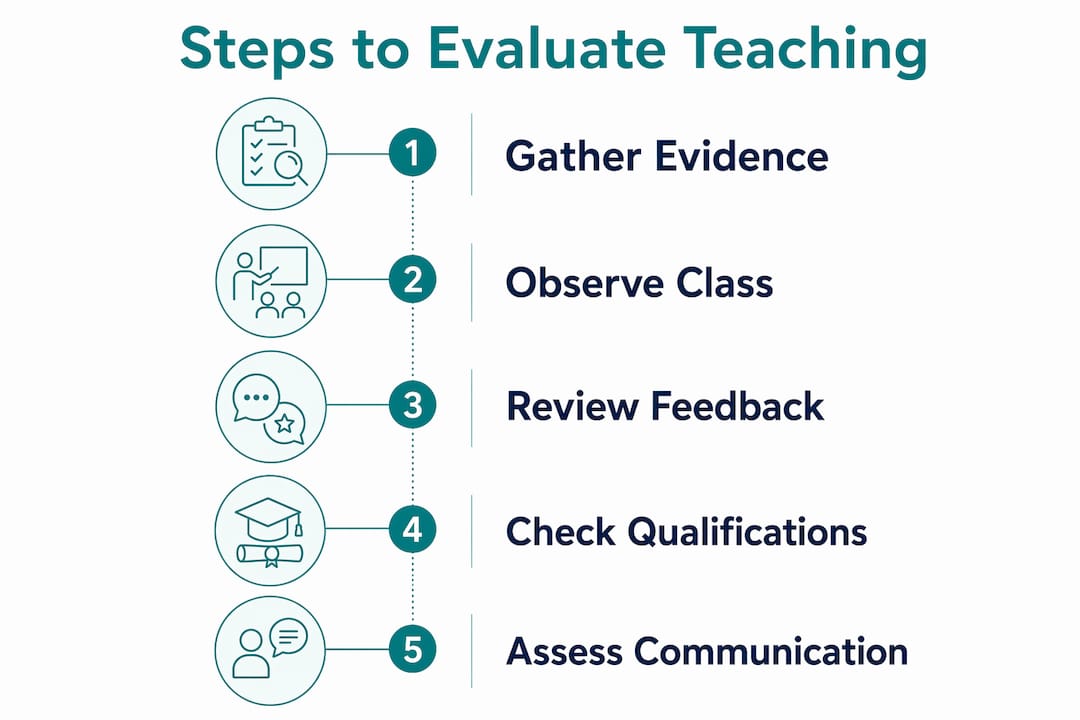
Effective teaching is not one thing. Shaun Simonson of Boise State University emphasizes that teaching effectiveness requires alignment of learning goals, classroom climate, and reflective integration of student feedback. The University of Kansas Benchmarks framework identifies seven dimensions of teaching practice, covering everything from course design and classroom climate to mentoring and reflection on student learning.
For parents evaluating schools for young children, these dimensions translate into observable questions:
Do teachers set clear, age-appropriate goals and connect daily activities to those goals?
Does the classroom feel welcoming and respectful for every child, including those with different learning styles?
How do teachers adapt when a child is struggling or excelling?
Is there evidence that teachers reflect on their practice and adjust over time?
Pro Tip: Ask to see a sample lesson plan or learning objective. A teacher who can explain why they structured a lesson a particular way, and what they would change next time, is demonstrating exactly the kind of reflective practice that research links to better outcomes.
Peer observation and collaborative review are also strong signals. Schools where teachers regularly observe each other and discuss what they saw are building a culture of continuous improvement, which benefits every child in the building.
Why classroom processes matter more than short-term test scores
The Stanford Center for Education Policy Analysis makes clear that measuring school quality only by short-term test scores misses key benefits. Observational measures of classroom processes, when conducted by trained reviewers, offer a better predictor of long-term educational outcomes. Test scores capture a narrow slice of what children gain from good teaching.
For children aged 1.5–12, this matters especially. A four-year-old’s ability to collaborate, ask questions, and persist through difficulty is not captured by any standardized test. What you can observe is whether the teacher creates conditions where those skills develop naturally.
Look for these process indicators:
Teachers who ask open-ended questions rather than fishing for a single correct answer.
Lessons that adapt mid-session when children lose focus or need more challenge.
Feedback that is specific, timely, and encouraging rather than generic praise.
Evidence that children’s progress is tracked across multiple dimensions, not just academic benchmarks.
Ask schools how they communicate progress beyond report cards. A school that can describe formative feedback loops, portfolio assessments, or regular teacher-parent conversations about individual children is prioritizing process quality.
How to read teacher communication and engagement
The way a teacher communicates with children reveals a great deal about their effectiveness. Watch for whether the teacher gets down to the child’s physical level during conversations, uses the child’s name naturally, and responds to questions with genuine curiosity rather than redirection. These are not small details. They reflect whether a teacher sees each child as an individual.
Engagement shows up in how children behave, not just how teachers perform. A classroom where most children are actively involved, where questions come from the students as much as from the teacher, and where mistakes are treated as learning opportunities rather than failures, is a classroom where effective teaching is happening. The E3 method offers one structured approach educators use to build this kind of engagement systematically.
What teacher qualifications and ongoing training signal
Credentials matter, but they are a starting point rather than a conclusion. A teacher’s initial qualifications tell you they met a baseline standard. What tells you more is whether they have continued learning since then. Schools that invest in ongoing professional development, whether through workshops, coaching, peer learning communities, or curriculum training, are signaling that they take teaching quality seriously as a living standard rather than a fixed credential.
Ask schools what professional development teachers completed in the past year and how that learning showed up in the classroom. Teacher qualifications and ongoing training play a vital role in maintaining the kind of adaptive instruction that young children need, particularly in mixed-ability or multilingual classrooms. A teacher who stopped learning the day they graduated is not the same as one who attended a curriculum workshop last month.
How parental involvement shapes teaching effectiveness
Parents who engage actively with a school tend to get more from it, and so do their children. This is not simply about attending events. It is about building a genuine relationship with teachers so that information flows both ways. When a teacher knows that a child is going through a difficult period at home, they can adjust their approach. When a parent understands what the class is working on, they can reinforce it naturally at home.
Schools that welcome parental involvement, through regular communication, open-door observation policies, and genuine feedback channels, tend to have stronger teaching cultures overall. Ask how the school communicates between formal report periods, and whether parents have any structured opportunity to share observations about their child’s experience. That two-way channel is one of the clearest signs that a school treats teaching as a collaborative process rather than a closed system.
Astor International School: where quality teaching is built in
Edu’s Astor International School in Singapore is the kind of place where the principles in this guide are already embedded in daily practice. Small class sizes mean every child from age 1.5 through 12 is genuinely seen and supported, not just managed. Teachers know their students well enough to adapt in real time, which is exactly the kind of responsiveness that research identifies as a hallmark of proficient teaching.

Astor has been recognized as both the best small school and the best affordable international school in Singapore, awards that reflect a consistent commitment to quality rather than scale. The preschool’s two playgrounds blend outdoor and classroom learning in a way that supports the whole child, while the primary school’s International Primary Curriculum is structured around inquiry, reflection, and real-world connection. If you are looking for a school where teacher development is ongoing and every child’s progress is tracked with care, Astor is worth a close look.
Key Takeaways
Evaluating teaching quality requires multiple evidence sources, trained observation, and a school culture that prioritizes continuous teacher growth over numerical rankings.
Point | Details |
Use multiple lenses | Combine instructor self-reflection, peer observation, and student feedback for a balanced view. |
Distrust rankings alone | Numerical scores reflect bias and context gaps; qualitative evidence reveals far more. |
Prioritize classroom processes | Observable practices like adaptability and student engagement predict long-term outcomes better than test scores. |
Ask about professional development | Schools where teachers keep learning produce more adaptive, responsive instruction for young children. |
Edu at Astor International School | Small classes, award-winning recognition, and an IPC curriculum built around reflective, personalized teaching. |
Recommended
I read your post and I found it amazing! thank! Airconditioning Limburg
cool stuff you have and you keep overhaul every one of us Thuisbatterij kopen
You completed a number of nice points there. I did a search on the issue and found nearly all people will have the same opinion with your blog. Zonnepanelen en batterij
Your work is very good and I appreciate you and hopping for some more informative posts Prijs Huawei thuisbatterij
I’m excited to uncover this page. I need to to thank you for ones time for this particularly fantastic read !! I definitely really liked every part of it and i also have you saved to fav to look at new information in your site. Prijs Huawei thuisbatterij