


Why bilingual education in Singapore benefits expat kids
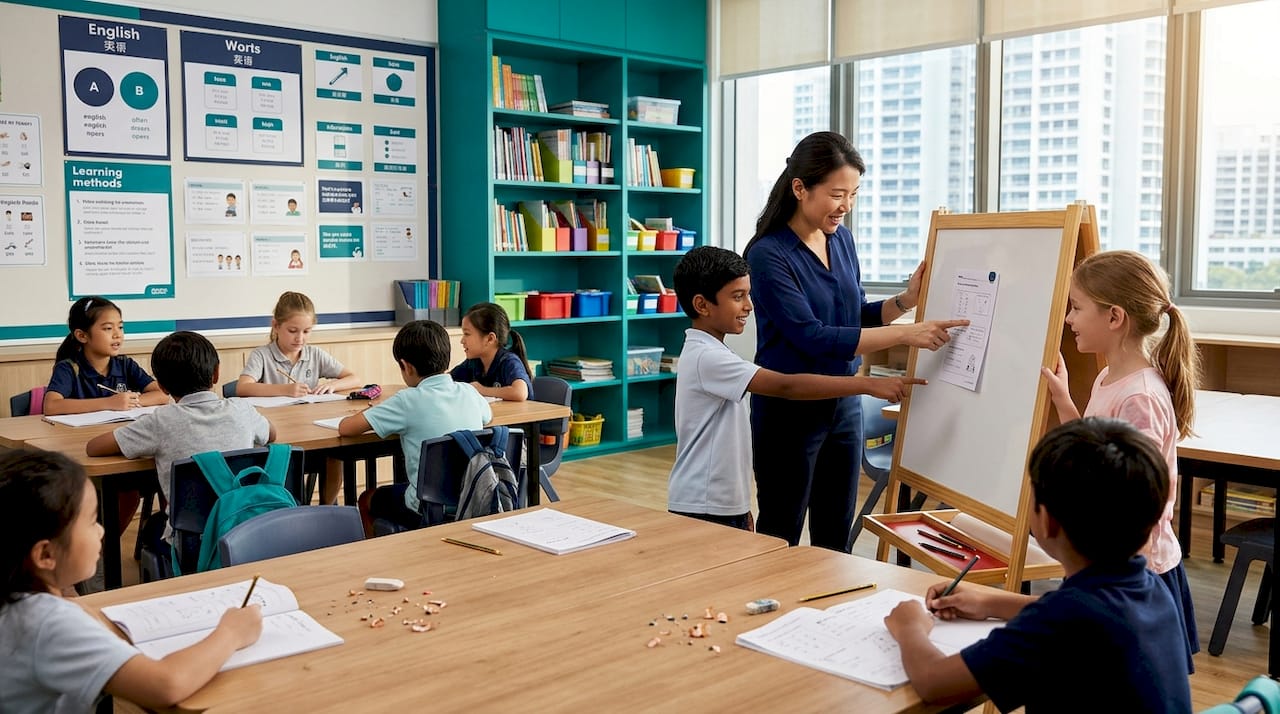
Many expat parents arrive in Singapore with genuine concerns: will learning a second language overwhelm their child, create unnecessary stress, or slow down their academic progress? The reality is quite the opposite. Singapore’s bilingual education model is one of the most carefully structured and research-supported approaches in the world, and children aged 5 to 12 are at the ideal stage to absorb its benefits. This guide walks you through how the system works, what your child stands to gain academically and socially, and how your family can make the most of this remarkable opportunity.
Table of Contents
Key Takeaways
Point | Details |
Flexible support options | Singapore’s bilingual system tailors support for different proficiency levels to help all students succeed. |
Long-term academic gains | Bilingual education boosts cognition, exam readiness, and real-world social skills for expat children. |
Parental involvement matters | Your family’s attitude, routines, and encouragement are key to your child’s bilingual success, even if you’re not fluent. |
Continuous policy improvements | Ongoing reforms and community funding ensure bilingual education remains effective and inclusive. |
How bilingual education is structured in Singapore primary schools
Before understanding the advantages, let’s clarify how bilingual education operates day-to-day in local primary schools.
Singapore’s bilingual policy requires every student in a Ministry of Education (MOE) school to study both English and a Mother Tongue Language (MTL). English serves as the primary medium of instruction across all subjects. The MTL is typically Mandarin, Malay, or Tamil, assigned based on a child’s ethnic background or, for expat families, by agreement with the school and MOE guidelines.
This dual-language requirement is not a recent experiment. Singapore has been refining this approach for decades, and the latest policy enhancements reflect the government’s commitment to keeping the system relevant and supportive for every child.
One of the most important things expat families should understand is that the system is not one-size-fits-all. MOE has built in significant flexibility to meet children at their actual proficiency level:
Foundation MTL is available for students who need more time and support to build competence.
Mother Tongue Support Programmes (MTSP) provide targeted help for students who find their MTL particularly challenging.
Higher MTL is offered for children who are already proficient and want to deepen their skills.
MTL SOAR (a newer reading-focused initiative) specifically addresses literacy gaps in reading comprehension within the MTL.
Families unfamiliar with international schools basics may be surprised to learn that even fully international schools in Singapore often offer bilingual enrichment, so this structure is relevant regardless of which school path you choose.
Here is a quick overview of how support is organized by proficiency level:
Proficiency level | Program available | Key focus area |
Advanced | Higher MTL | Deeper language and literary skills |
On-track | Standard MTL | Core language competency |
Developing | Foundation MTL | Foundational vocabulary and literacy |
Needs support | Mother Tongue Support Programme | Targeted reinforcement and confidence-building |
Reading gap | MTL SOAR | Reading fluency and comprehension |
The differentiated support structure means that your child does not have to be naturally gifted in their MTL to succeed. The system is designed to meet them where they are, then steadily build their skills. For expat families who are new to this environment, that flexibility is genuinely reassuring.
Academic and cognitive benefits of bilingualism for children
Once you understand the system’s structure, it’s important to know what your child stands to gain from participating.
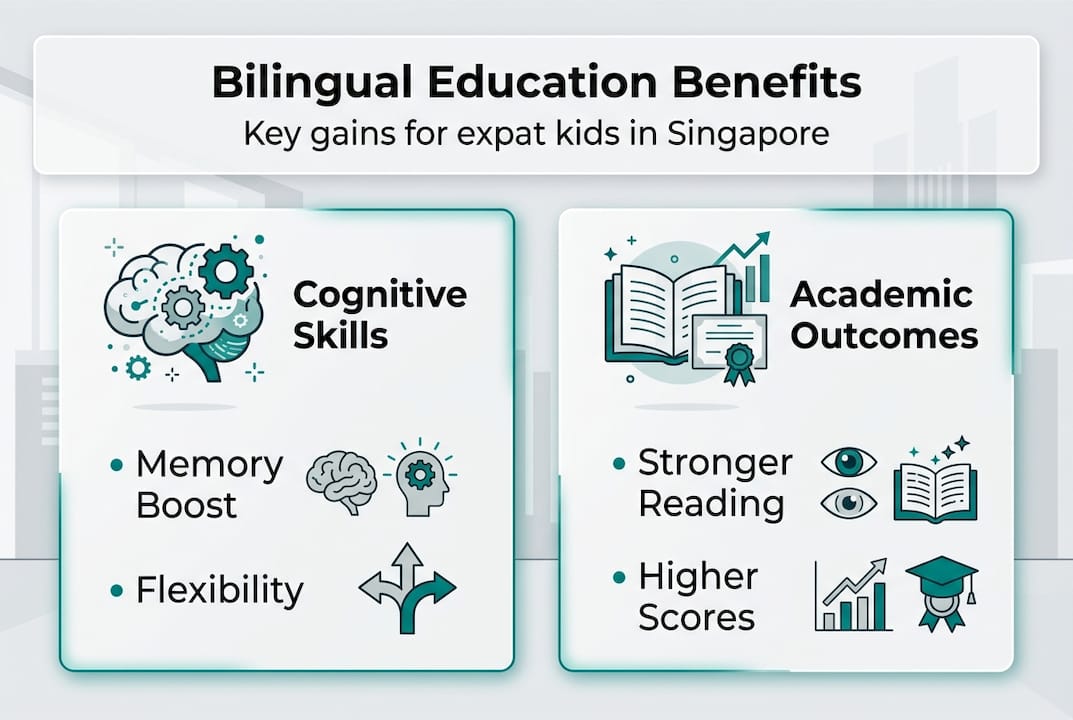
The research on bilingualism and child development is clear and consistent. Children who actively use two languages tend to develop stronger cognitive flexibility, which means they are better at switching between tasks, filtering out irrelevant information, and approaching problems from more than one angle. These are not just language skills. They are thinking skills that carry over into mathematics, science, reading comprehension, and virtually every academic subject.
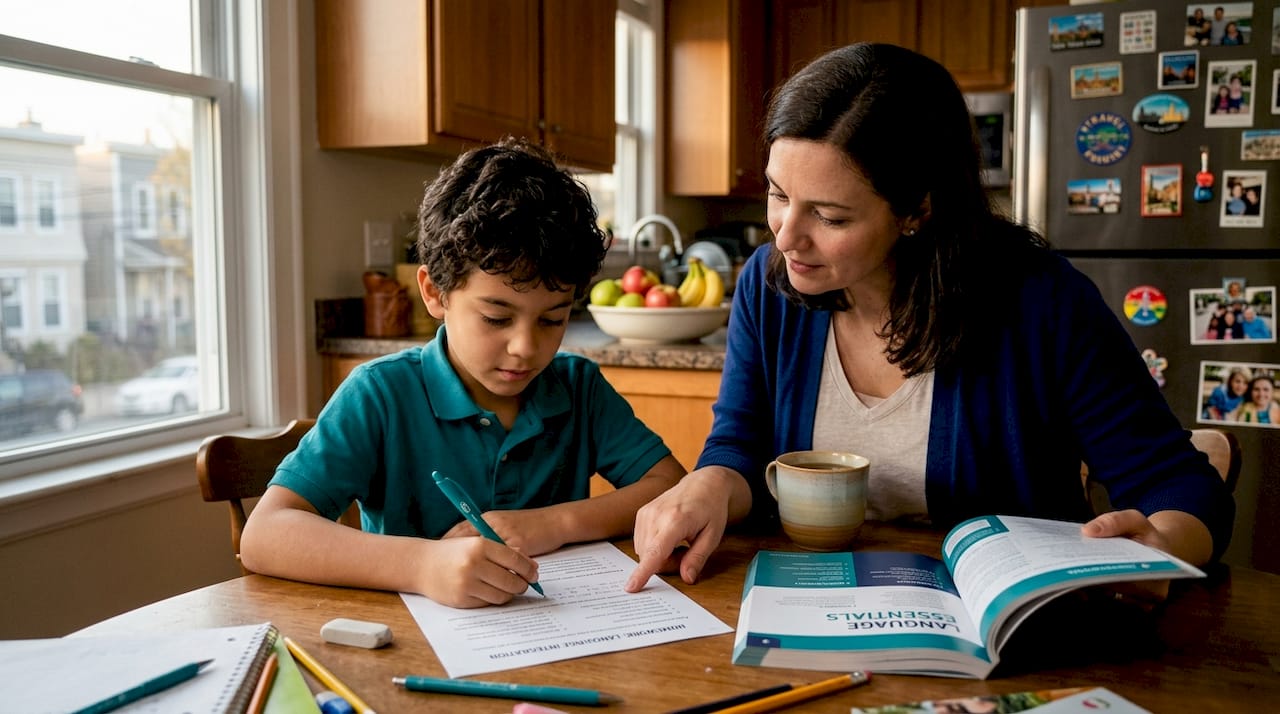
For children aged 5 to 12, this period represents a critical window for language acquisition. The brain is especially receptive during these years, making it far easier to internalize pronunciation, grammar patterns, and vocabulary in a second language than it will be later in life. Children who engage in genuine bilingual education during this period tend to retain stronger language skills well into adulthood.
From an academic readiness standpoint, bilingual education builds measurable advantages in exam performance, reading speed, and comprehension. Beyond tests and grades, bilingual children demonstrate a greater ease in navigating diverse social environments. They become more attuned to tone, context, and cultural nuance, which builds genuine emotional intelligence.
Here is a useful comparison:
Outcome area | Monolingual children | Bilingual children |
Cognitive flexibility | Developing | Significantly stronger |
Problem-solving | Standard progression | Often accelerated |
Cultural sensitivity | Limited to home culture | Broader, more adaptive |
Long-term career readiness | Regional scope | Global scope |
Academic exam readiness | Standard | Enhanced in multiple subjects |
The social advantages deserve special attention for expat families. Your child is already navigating the experience of living in a new country. Adding a meaningful second language gives them a genuine connection point with local peers and communities. Rather than remaining on the outside, they begin building real bridges.
Pro Tip: Support academic language at home by reading bilingual picture books together or watching short videos in your child’s MTL. You do not need to be fluent yourself. The exposure and your positive engagement are what matter most. Resources like those shared in our guide on tips to boost language skills can make this feel natural and fun rather than like extra homework.
It is also worth noting that smaller class environments make a meaningful difference here. When a child has space to practice language with genuine teacher feedback, growth accelerates. You can read more about why small class sizes help in building language confidence specifically.
How schools teach: Approaches and parental role
Knowing the benefits, expat parents often ask how these advantages are developed in the classroom and how they can help at home.
Singapore’s approach to bilingual instruction has evolved considerably over the years. Early childhood and lower primary teaching emphasizes play-based, interactive experiences that make language feel natural rather than formal. As children move through primary school, structured methods take over, including explicit grammar instruction, reading aloud, and guided writing in both English and the MTL.
A key insight from recent educational research is that children do not learn languages in isolated silos. As noted in current bilingual education research, effective instruction uses “comprehensible input” and dual-teacher models, where an English-medium teacher and an MTL teacher work in parallel. This allows children to make natural connections between the two languages, rather than treating them as entirely separate systems.
The progression in most classrooms follows a logical sequence:
Listening and speaking first. Children develop an ear for the language before they are asked to read or write in it. This mirrors how native speakers acquire their first language and reduces early anxiety.
Vocabulary building through context. Rather than rote memorization, teachers use stories, play, and real-world scenarios to introduce new words with meaning attached.
Reading fluency development. Once listening and speaking feel comfortable, structured reading follows. Programs like MTL SOAR target specific gaps in this area.
Writing and composition. This comes last, as it requires the most formal mastery. Students are guided gradually from simple sentences to more complex expression.
“Bilinguals draw cross-language connections naturally. Parental positive attitude is key for motivation.” Rethinking Bilingual Education in Multilingual Singapore
This quote captures something important. Your child’s brain is already wired to make connections between languages. What you provide at home, especially your attitude toward the MTL, shapes how motivated they feel to use those connections.
You do not need to speak Mandarin, Malay, or Tamil fluently to support your child. What matters is consistency and encouragement. Our guide on classroom learning strategies offers specific, practical ideas for parents who want to reinforce what their child is learning at school, even without personal fluency in the MTL.
Pro Tip: Avoid expressing frustration or negativity about the MTL in front of your child, even casually. Children pick up on parental attitudes quickly. When they hear you treat the language as meaningful and interesting, they internalize that same respect.
Challenges and how Singapore helps families succeed
While bilingual education offers many advantages, it is important to acknowledge and address the unique challenges expat families may face.
The most common difficulty is limited exposure to the MTL outside of school. In English-dominant households, which describes most expat families, children simply hear and use the MTL far less than their local peers. This creates a proficiency gap that can widen over time if not addressed. Some children also perceive their MTL as harder or less important precisely because it is not used at home or in their social circles.
There is also natural variation within classrooms. Because Singapore draws children from incredibly diverse backgrounds, a single MTL class might include native speakers alongside children encountering the language for the first time. This range can sometimes make a child who is at an early stage feel self-conscious. Awareness and honest conversation with your child’s teacher goes a long way in managing this.
The Singapore government has recognized these challenges and responded with meaningful support. As highlighted in recent education research, declining MTL proficiency in English-dominant households is a documented trend, and it has prompted significant policy responses. Mother Tongue Language Learning and Promotion Centres (MTLLPCs) have received $33 million in dedicated funding to expand community-based language programs and make resources more accessible to families outside the traditional school setting.
At the school level, continuous policy adaptation ensures that programs remain tailored to real student needs rather than fixed assumptions about who speaks what at home.
Here is a quick reference to the main support systems available:
Support program | Who it helps | Key benefit |
Mother Tongue Support Programme | Students with low MTL proficiency | Targeted reinforcement |
Foundation MTL | Students needing more time | Reduced pace, stronger foundations |
MTL SOAR | Students with reading gaps | Reading fluency focus |
MTLLPCs | Families and community groups | Out-of-school language enrichment |
Higher MTL | Advanced students | Deepened skills and literature exposure |
Common challenges expat families face, along with proven strategies to address them, include:
Limited home exposure to MTL: Counter this by incorporating media, music, and books in the language at home, even passively.
Child’s negative attitude toward MTL: Keep the tone positive. Celebrate small wins and connect the language to something the child finds exciting.
Proficiency variation in the classroom: Communicate openly with teachers and ask about available support tracks or supplementary programs.
Uncertainty about which MTL to select: Consult the school early and honestly about your child’s background and comfort level. Our guide on school choices for expat kids can also help you think through the broader picture.
Expat families who approach the bilingual journey with curiosity and flexibility tend to find that the support systems available in Singapore are genuinely generous. You are not alone in navigating this.
What most guides miss about bilingual education for expat families
Most articles focus on curriculum, policy, and programs. Those things matter. But in our experience working with expat families across Singapore, the single biggest predictor of a child’s bilingual success is not which program they are enrolled in. It is the family’s attitude and everyday behavior at home.
Parents who treat the MTL as meaningful, even if they cannot speak it themselves, raise children who approach it with confidence. Parents who routinely express that it is “too hard” or “not really necessary” unintentionally reinforce avoidance. The curriculum is important, but it cannot replace the emotional environment you create at home.
The expat experience is actually a genuine advantage here. Your family already knows what it means to adapt, to embrace new contexts, and to hold multiple cultural identities at once. That flexibility, applied to language learning, is powerful. Bilingualism does not require perfection. It requires consistency, patience, and a willingness to celebrate imperfect effort.
Explore more about building this kind of holistic education for expats to see how the full picture comes together beyond the language classroom.
Pro Tip: Create a small weekly family ritual around the MTL, whether that is watching a short cartoon, cooking a dish connected to the language’s culture, or simply asking your child to teach you three new words they learned that week. These small, consistent moments build more confidence than extra tutoring sessions alone.
How Astor International School supports your family’s bilingual journey
If you are looking for a school environment where your child can thrive as both a learner and a young person, Astor International School in Singapore’s Tanglin area offers exactly the kind of nurturing, personalized experience that makes bilingual growth possible.
Astor is a small but mighty school, awarded Best Small School in Singapore and Best Affordable International School in Singapore, with class sizes designed so that every child is truly seen and supported. Our IPC curriculum integrates language learning meaningfully across subjects, while our enrichment classes offer additional language development pathways tailored to each child’s needs. We warmly invite you to learn more about our school and reach out to arrange a personal tour. Bilingual education is a journey, and we would love to be part of yours.
Frequently asked questions
Can expat children choose their Mother Tongue Language (MTL) in Singapore?
Yes, expat children can usually select an MTL based on their family’s background, though they must follow MOE guidelines and seek school approval for non-standard selections.
Is bilingual education mandatory in all Singapore primary schools?
Yes, all students in MOE schools must study English and one designated MTL as part of the national curriculum, with no opt-outs available.
What if my child is weak in their selected MTL?
Schools offer differentiated support including Foundation MTL and the Mother Tongue Support Programme, specifically designed to help less proficient students build skills at a manageable pace.
How can I support my child’s MTL at home if I am not fluent?
Maintaining a positive attitude toward the language and setting small, consistent routines for exposure, such as media or community programs, is more impactful than fluency.
Recommended

Comments