


Curriculum Selection Guide for Expat Parents in Singapore

Choosing the right curriculum for your child is one of the most consequential decisions you will make as an expat parent in Singapore. With over a dozen international curricula available across hundreds of schools, and your family’s future relocation always a real possibility, this curriculum selection guide is built to help you cut through the noise. You will find a clear breakdown of your options, the key factors that actually matter, and a practical step-by-step process. Whether your child is 18 months or 11 years old, the goal here is the same: confident, well-informed choices that put your child first.
Table of Contents
Key Takeaways
Point | Details |
Match curriculum to residency length | Families staying short-term benefit most from portable curricula like IB or British; longer stays may suit MOE local pathways. |
Portability matters more than prestige | Choose a curriculum your child can continue after Singapore, not just the most recognized name on the island. |
Age and learning style shape fit | Your child’s developmental stage, language needs, and individual learning profile should guide your shortlist. |
School visits reveal what paperwork cannot | Asking schools directly about mid-year transfers and transition support tells you far more than a brochure ever will. |
Start the process early | Admission timelines, document requirements, and waiting lists can surprise even well-prepared families. |
Understanding curriculum options for expat children
Singapore offers one of the most varied education environments in Asia. That breadth is both an asset and a source of genuine confusion. Here is what you need to know about the main options available to expat families.
International Baccalaureate (IB). The IB Primary Years Programme serves children aged 3 to 12 through six transdisciplinary themes that guide inquiry-based learning. The framework is flexible enough that IB PYP schools tailor their inquiry themes to their community’s cultural context. This makes it a strong choice for children from diverse backgrounds and families who may move again. The IB pathway continues through the Middle Years Programme and Diploma Programme, giving it genuine long-term continuity.
British curriculum. Schools offering the Cambridge IGCSE and A Levels follow a highly structured, subject-based progression. It is widely recognized globally, which is a real advantage if your family’s next destination is the UK, Europe, or a country with strong British education links. The structured assessment style suits children who thrive with clear academic benchmarks.
American curriculum. American-based schools typically prepare students through a grade-level system aligned with US standards, with AP courses available at the secondary level. If you are likely to return to the United States, or if your child may attend a US university, this consistency is meaningful.
Singapore MOE local curriculum. The MOE curriculum focuses on mastery, problem-solving, and 21st century competencies within a structured syllabus. It emphasizes conceptual understanding rather than rote learning. Most expat families pursuing this path are planning a longer residency in Singapore, as the curriculum culminates in the PSLE, which does not transfer easily to international pathways.
Bilingual and immersion programs. A growing number of schools offer bilingual instruction in English and Mandarin, or English and French. These programs serve multilingual families well and can give children a meaningful linguistic advantage.
Hybrid pathways. Hybrid approaches combining international and local elements are increasingly common, particularly among families who want the flexibility of an international curriculum alongside Singapore’s academic rigor. Bilingual private schools and tutoring centers that supplement international curricula fall into this category.
Curriculum | Best for | Portability |
IB PYP | Ages 3-12, inquiry-based learners | Very high |
British (Cambridge) | Structure-oriented, UK-bound families | High |
American | US-bound families, AP track | High |
Singapore MOE | Long-term residents, local pathways | Low |
Bilingual/Hybrid | Multilingual families, flexible goals | Medium-High |
Key factors to consider before you choose
Getting this decision right means looking beyond school rankings. The factors below are what actually predict a good fit for your child.
Your family’s expected length of stay. This is the single most important variable. Most expat families choose international schools for short-to-mid stays and MOE local schools for longer residency. If you are on a two-year posting, building toward a PSLE is unlikely to serve your child well when you relocate.
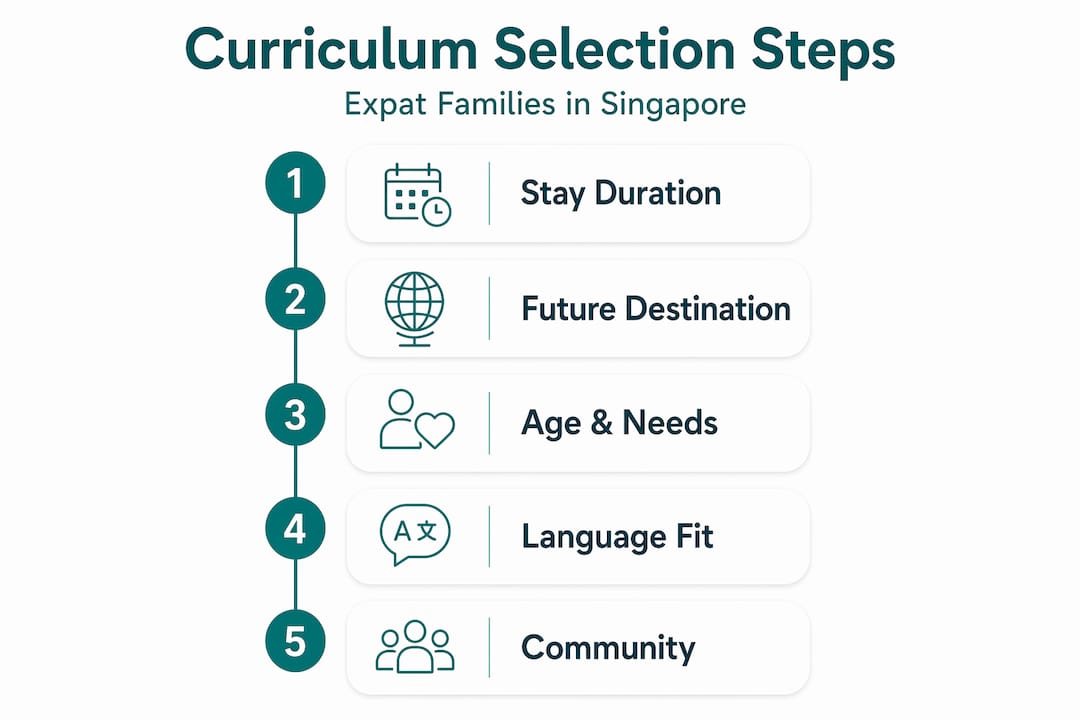
Future destination. Curriculum portability and alignment with your next move is critical. If you know your family will eventually move to Germany, Australia, or Canada, research how each curriculum maps onto university entry requirements in those countries. The IB Diploma is recognized by universities in over 90 countries. That matters.
Your child’s age and learning profile. A curious four-year-old who loves hands-on exploration will likely thrive in a play-based or inquiry-driven program. An eight-year-old who has been in a structured British system may find a completely unstructured transition disorienting. Think about learning style, not just academic level.
Special educational needs and support. High-quality early years curricula intentionally include adaptations for children with disabilities and scaffolded learning supports. Not every school in Singapore offers the same level of learning support, and some international curricula build it in more deeply than others. Ask schools directly what support looks like in practice.
Language and cultural responsiveness. Culturally responsive teaching and individualized support for multilingual learners are markers of a high-quality curriculum, particularly for young children. If your child speaks a language other than English at home, ask how the school supports mother tongue development alongside English instruction.
Community fit. Your child’s happiness at school is shaped significantly by the community around them. A school where families share similar mobility experiences tends to offer stronger peer support and more practical understanding of the transitions expat children face.
Pro Tip: When comparing schools, ask specifically about their experience with children who arrived mid-year. How a school handles that transition tells you a great deal about its actual culture, not just its curriculum framework.
A step-by-step process for selecting a curriculum
Knowing your options is one thing. Moving from that knowledge to a confident decision is another. Here is a practical process that works for most expat families in Singapore.
Define your family’s constraints first. How long are you likely to be in Singapore? Where might you go next? What is your child’s current curriculum, and how disruptive would a change be? Write these answers down before you start browsing school websites.
Research and shortlist curricula. Use your constraints to filter. A family on a rolling two-year contract should focus on internationally portable options. Once you have narrowed to one or two curriculum types, start building a list of schools that deliver them well. Resources like this international curriculum overview can help you map your options.
Engage with the curriculum framework directly. If you are considering the IB PYP, read how the programme’s inquiry themes work and think honestly about whether your child’s learning style aligns. If you are considering the British system, look at how assessments work at your child’s year level.
Schedule school tours and ask focused questions. Do not treat tours as a formality. Ask how the school handles mid-year transfers and curriculum continuity. Ask what the average class size is. Ask whether the learning support team is embedded in the classroom or external.
Compare curriculum structure and teaching approaches. Put two or three schools side by side.
Factor | Questions to ask |
Assessment style | Exams, portfolios, or continuous assessment? |
Class size | How many students per teacher? |
Mid-year entry | Is it supported and how is it managed? |
Language support | What is available for non-native English speakers? |
Special needs support | What learning support staff are on site? |
Check admission requirements and timelines. For MOE local schools, the Additional Entry International Student (AEIS) test has specific registration windows. International schools vary widely. Start this process earlier than you think necessary. Waiting lists are real and do catch families off-guard.
Make your decision and prepare for enrollment. Once you have chosen, prepare your child for the transition. Talk about what their new school will look like, who their teacher will be, and what a typical day involves. Practical preparation reduces anxiety considerably.
Pro Tip: Ask each school you visit whether they have a dedicated transition coordinator or buddy system for new students. This single detail signals how much the school has institutionalized support for mobile families, which is exactly what your child needs.
Common pitfalls in curriculum selection
Even thoughtful, well-researched parents make avoidable mistakes. These are the most common ones worth knowing in advance.
Choosing by reputation alone. A school’s prestige ranking does not tell you whether its curriculum suits your child’s learning style, your family’s mobility, or your future destination’s university requirements. Fit matters more than fame.
Ignoring future mobility. Curriculum choice should always account for your next destination, not just your current situation. Many families learn this lesson the hard way when they relocate and discover their child’s qualifications do not transfer smoothly.
Overlooking language and cultural needs. Selecting educational materials that treat all children as native English speakers will put multilingual children at an immediate disadvantage. The quality of a curriculum’s multilingual support is not a nice-to-have. It shapes daily learning.
Underestimating admission timelines. Some international schools in Singapore have waiting lists of six months or more. Arriving in August and expecting to start in September is rarely straightforward for popular schools.
Not asking about special needs support. Even if your child does not currently have identified needs, ask about how the school supports diverse learners. A school with strong learning support culture creates a better environment for every child.
“The best curriculum is not the one with the most impressive name. It’s the one where your child feels genuinely seen, supported, and excited to learn every day.”
Supporting your child after you have chosen
Making the decision is the first chapter, not the last. How you support your child through the transition and beyond shapes their actual experience of the curriculum you have chosen.
Understanding the assessment milestones in your child’s new curriculum helps you know what to expect and when to step in. IB PYP schools use portfolios and learning exhibitions rather than formal exams, while British system schools introduce structured testing earlier. Knowing the difference means you can prepare your child rather than react to surprises.
Engage with teachers early and often. Teachers in small-class international schools are genuinely accessible, and building that relationship in the first term pays dividends throughout the year. Ask for regular feedback rather than waiting for formal reports.
Watch your child’s emotional wellbeing as closely as you watch their academic progress. A child who is socially settled will learn more effectively than one who is academically prepared but struggling to find their place. Look for signs of connection: friendships forming, enthusiasm about school stories at dinner, comfort with the daily routine.
If gaps emerge, act early. Enrichment programs designed for international students can provide academic reinforcement without the pressure of formal tutoring, and many Singapore-based programs understand the specific needs of mobile children.
My perspective on what really matters here
I have worked with expat families navigating curriculum choices for many years now. And the honest truth is that the families who make the best decisions are almost never the ones who did the most research. They are the ones who asked the most honest questions about their own situation first.
I have seen families pour energy into comparing IB versus British assessments while completely sidestepping the fact that they were likely moving to Japan in 18 months. The curriculum portability question is genuinely the one that matters most, and it is the one parents most often defer.
What I believe strongly is this: culturally responsive curriculum is not a secondary concern. It is central. A child who sees their background reflected in their learning environment is a child who belongs there. That sense of belonging accelerates everything else.
My advice on patience might surprise you. The selection process feels urgent, especially when you have just landed in a new country. But rushing it produces mismatches that cost far more time later. Give yourself permission to take six to eight weeks to visit, ask questions, and sit with the decision.
I am genuinely excited about hybrid models. The idea that a child can access Singapore’s mathematical depth while developing international cultural fluency within an IB framework is not a compromise. It is the best of both worlds, and schools that execute it well are the ones worth finding.
— Elena
How Astor supports expat families like yours
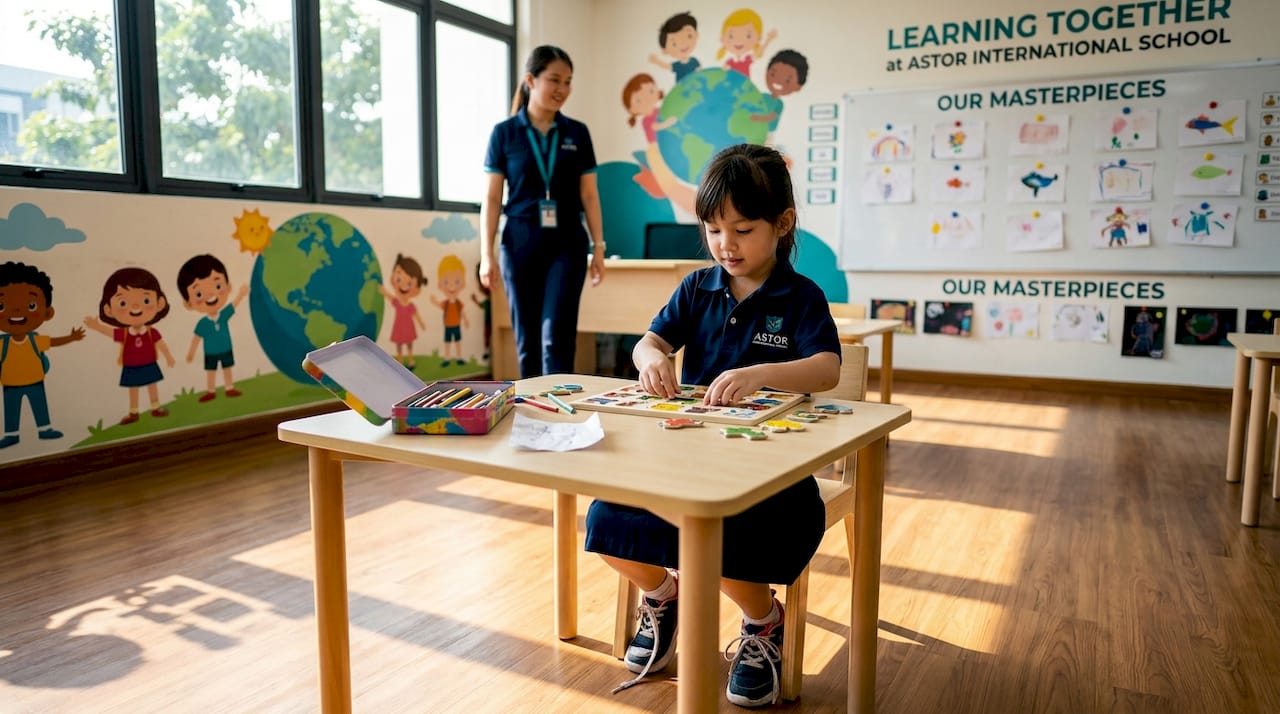
At Astor International School, we understand that choosing a curriculum is deeply personal. Our award-winning school in Singapore’s Tanglin area has been recognized as the best small school and best affordable international school in Singapore, and we believe that reputation is built one child at a time. We deliver the International Primary Curriculum designed specifically for internationally mobile families, with multilingual support woven into daily learning rather than added as an afterthought. Our small class sizes mean every child is genuinely known by their teacher, not just enrolled in a program. For our youngest learners, Astor International Preschool in Holland offers a nurturing mix of outdoor and classroom learning across two playgrounds. If you are ready to see what the right curriculum fit looks like in practice, explore our full curriculum approach or reach out to schedule a personal school visit.
FAQ
What curriculum is best for expat children in Singapore?
The IB Primary Years Programme is widely considered the most portable option for expat children aged 3 to 12, as it is recognized globally and serves families who may relocate. British and American curricula are also strong choices depending on your family’s likely next destination.
How do I start the curriculum selection process in Singapore?
Begin by defining your expected length of stay, likely next destination, and your child’s current learning environment. Then use those filters to shortlist curriculum types before researching specific schools, as outlined in our school navigation guide.
Should I choose a local MOE school or an international school?
Most expat families in Singapore choose international schools for shorter stays due to curriculum portability, while MOE schools suit families planning a longer, more permanent residency. The PSLE pathway is rigorous and rewarding but does not transfer easily to international systems.
How important is mid-year transfer support when choosing a school?
Very important. How schools manage mid-year transfers and curriculum continuity directly affects how smoothly your child transitions, especially in inquiry-based systems like the IB PYP where units build on each other progressively.
How early should I begin the admission process for international schools in Singapore?
Start at least three to six months before your intended start date. Popular international schools maintain waiting lists, and document requirements, including health records, transcripts, and passport copies, take time to compile and verify.
Recommended
Comments