


Why Enrichment Programs Matter for Expat Kids in Singapore

Many expat parents arrive in Singapore with a straightforward assumption: enroll your child in enrichment classes, and academic success will follow. It seems logical, especially in a city known for its rigorous education system and competitive learning culture. But the reality is more nuanced. Research conducted right here in Singapore reveals that enrichment programs do not deliver the same benefits for every child, and the outcomes can vary considerably depending on language background, developmental stage, and program fit. Understanding when and how enrichment truly works can help your family make smarter, more confident decisions.
Table of Contents
Key Takeaways
Point | Details |
Context influences impact | Enrichment effectiveness depends on your child’s linguistic profile and Singapore’s educational context. |
Not always immediate | Long-term gains from enrichment may take time or shift between skills like reading and math. |
Purposeful selection matters | Choose programs based on developmental needs, not just marketing claims or peer choices. |
Monitor and adjust | Track your child’s progress and revise enrichment choices for better alignment and outcomes. |
Flexible, not mandatory | Singapore’s enrichment options are designed to complement formal schooling and are optional for families. |
Understanding enrichment in Singapore’s education landscape
Enrichment programs are structured learning activities that go beyond the standard school curriculum. They are designed to deepen skills, spark curiosity, and extend learning in specific areas such as language, mathematics, science, arts, or coding. In Singapore, these programs range from holiday camps and after-school classes to weekend workshops and specialist tutoring centers.
Importantly, enrichment is not a replacement for school. It is complementary. Singapore’s Ministry of Education has moved toward a more flexible approach to advanced learning, and high-ability learners are now identified through new assessments to attend advanced modules outside of regular school hours. This participation is not mandatory. It is designed to match the pace and curiosity of children who are ready for more, without adding unnecessary pressure to those who are not.
Singapore’s enrichment model for high-ability pupils emphasizes enquiry-based learning, hands-on discovery, and flexible participation. The goal is to nurture genuine curiosity rather than accelerate rote learning.
For expat families, this is encouraging news. You are not expected to enroll your child in every available program. Instead, the focus is on intentional choices that serve your child’s specific needs. Here is a quick comparison to help clarify the difference between regular schooling and enrichment:
Feature | Regular schooling | Enrichment programs |
Hours per week | 25 to 35 hours | 1 to 6 hours |
Content focus | Broad curriculum | Targeted skill area |
Participation | Mandatory | Voluntary |
Primary objective | Foundational education | Extension and interest-based growth |
Flexibility | Fixed timetable | Varied schedules and formats |
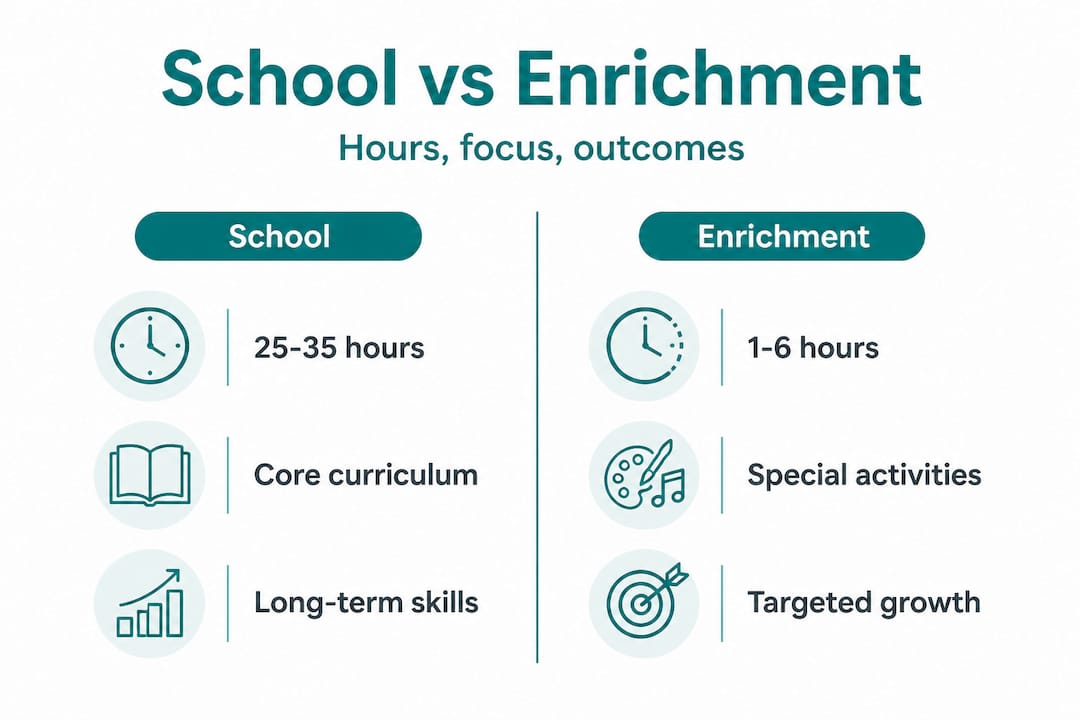
Common enrichment formats in Singapore include language classes in English or Mandarin, math and science enrichment, arts and music programs, holiday intensive camps, and after-school coding or STEM workshops. Each serves a different purpose, and not every format suits every child. As part of a thoughtful holistic education guide, enrichment works best when it is selected with care rather than convenience.
Now that you understand enrichment programs aren’t always mandatory, let’s dive deeper into how they actually affect learning in Singapore’s bilingual context.
Language learning: Does enrichment give every child an edge?
Language is one of the most popular areas for enrichment in Singapore, especially given the city’s bilingual education system. Many expat families want their children to strengthen English skills or gain confidence in Mandarin. But research tells a more complex story.
A study exploring language-focused enrichment in Singapore found that English enrichment outcomes were not significantly associated with better English receptive vocabulary or word-reading performance. In contrast, children who attended Mandarin enrichment classes showed meaningfully better Mandarin word-reading skills. This difference matters a great deal for expat families planning their enrichment investment.
Why does this gap exist? The answer lies in sociolinguistic exposure. Most children in Singapore, including expats, are already surrounded by English in their daily environment. School instruction, signage, media, and social interactions all reinforce English naturally. As a result, additional formal English enrichment may not provide enough of a boost beyond what the environment already delivers.
Mandarin is a different story. Unless your family speaks Mandarin at home or your child has strong exposure through a Chinese-medium program, formal Mandarin enrichment can play a meaningful role in building reading and character recognition skills. The benefits of bilingual education are well-documented, and strategic Mandarin support can genuinely help expat children access those advantages.
Enrichment in language learning tends to work best when these conditions are in place:
Your child has a clear gap in a language that is not reinforced at home or in their social environment
The enrichment curriculum aligns with what the school is teaching
The program uses communicative, interactive methods rather than purely drill-based instruction
Your child attends consistently enough to build genuine fluency rather than surface familiarity
Pro Tip: Before committing to a language enrichment program, spend a week observing how often your child uses that language outside of school. If the answer is rarely or never, enrichment may genuinely fill a developmental gap. If the language is already present in daily life, your investment may deliver less measurable return.
With the complexities of bilingual learning in mind, it’s important to move beyond language and consider how enrichment influences broader development over time.
Realistic expectations: Long-term and short-term outcomes
One of the most common misunderstandings about enrichment is that strong early results predict lasting success. Parents often see their child reading more fluently or solving problems faster after a few months of classes, and naturally assume those gains will compound over time. The evidence suggests this is not always the case.
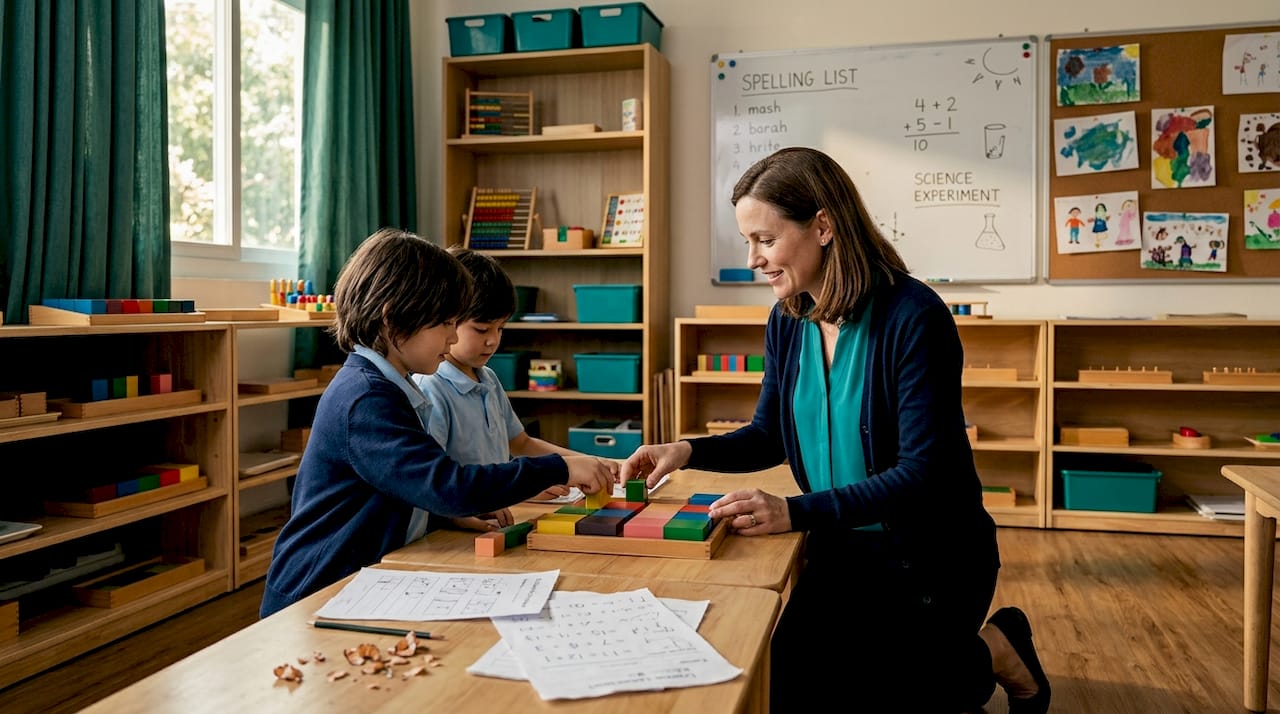
A randomized controlled trial examining an adapted Montessori curriculum found a fascinating pattern. Children in the Montessori program outperformed peers in reading during kindergarten. Yet five years later, there was no longer a meaningful difference in reading between the two groups. What had changed? A math problem-solving advantage had emerged in the Montessori group, one that was not visible at all during the kindergarten stage.
This finding is significant. It tells us that enrichment benefits may shift over time rather than disappear entirely. A skill that appears stronger early on may plateau, while other skills strengthen quietly in the background. This is not a reason to avoid enrichment. It is a reason to track the right things over a realistic timeframe.
Here is a practical framework for setting evidence-aligned objectives for your child’s enrichment:
Identify the specific developmental gap your child is experiencing, not a general wish for improvement but a concrete area such as phonics, number sense, or reading comprehension.
Set a realistic review timeline of at least six months before evaluating whether the program is working. Short cycles make it difficult to separate genuine progress from natural developmental growth.
Track qualitative changes, not just test scores. Notice whether your child is more curious, more confident, or more willing to attempt challenges in that subject area.
Adjust your approach if the program is not serving the original goal after a fair review period. Switching programs or reducing frequency is not failure; it is good parenting.
Research on immersive learning also supports this measured approach, showing that deep engagement over time produces more lasting results than intensive short-term exposure. Understanding effective classroom learning strategies can further help you recognize whether your child’s enrichment program is genuinely aligned with how children learn best.
Pro Tip: Resist the pull of programs that promise rapid test score improvements. Those gains are often temporary. Choose enrichment that builds foundational skills and genuine interest in a subject, because that combination tends to produce results that actually last.
To make the most of enrichment, let’s look at practical strategies for families to select the right programs and monitor their child’s progress.
Practical strategies: Selecting and tracking enrichment for your child
Choosing an enrichment program for your child can feel overwhelming, especially when you are new to Singapore and faced with a wide range of options. The good news is that a few clear criteria can make the decision much more manageable.
When evaluating programs, focus on these key areas:
Goal alignment: Does the program target the specific skill or area where your child needs support or would benefit from extension?
Child profile fit: Is the program designed for your child’s age, learning style, and current ability level? A program that is too advanced can discourage; one that is too easy can bore.
Schedule sustainability: Can your family maintain consistent attendance without creating stress? Enrichment should add value, not fatigue.
Outcomes transparency: Does the program communicate clearly about what children will be able to do after completing it? Vague promises about “building confidence” without concrete skill markers deserve closer scrutiny.
Instructor quality: Are the educators experienced in working with young learners and familiar with the cultural diversity present in expat families?
Expert educators recommend reviewing your child’s progress after a structured period, typically one school term or roughly ten weeks, and asking both the instructor and your child how it is going. Children who enjoy their enrichment and feel challenged in a positive way are far more likely to retain and apply what they learn.
Supporting your child’s learning at home also plays a critical role. Enrichment alone cannot carry all the weight. Reading together, discussing ideas, and exploring subjects that genuinely interest your child reinforces whatever is being built in the classroom. Personalized learning in practice shows us that children thrive when their learning environment responds to who they are, not just what a curriculum requires.
Pro Tip: Let your child have a voice in choosing enrichment activities. When children feel ownership over their learning schedule, they engage more deeply and persist through challenges with far more resilience than when programs are chosen entirely by adults.
Now, let’s share a unique perspective based on the realities expat families face, and what truly matters in leveraging enrichment for long-term growth.
A fresh perspective: What expat families should really know about enrichment
Here is something most enrichment marketing will never tell you: the programs with the loudest promises often deliver the most modest results.
We have seen many families arrive in Singapore with a carefully planned enrichment schedule, driven by the fear of falling behind in one of Asia’s most academically focused cities. The instinct is completely understandable. But the evidence consistently shows that more classes do not automatically mean more growth. In fact, children who are overloaded with structured activities often show signs of disengagement, reduced creativity, and lower motivation over time.
The families who navigate enrichment most successfully in Singapore tend to share a common mindset. They treat enrichment as a targeted tool, not a safety net. They ask specific questions about their child’s developmental needs before signing up for anything. And they stay willing to stop, adjust, or switch programs when something isn’t working, without guilt.
As research reminds us, enrichment outcomes can shift over time in ways that are genuinely hard to predict. A skill that improves early may plateau, while a different strength emerges later. The most honest thing we can say is that enrichment works best when it is chosen purposefully for your individual child.
The other thing worth saying clearly: not every child needs enrichment at every stage. Some children are thriving within their school environment and need unstructured time to play, explore, and rest. Protecting that time has its own developmental value. Our holistic education guide reflects our belief that the best outcomes come from balance, not from maximizing structured learning hours.
Enrichment is not the problem. Unrealistic expectations are. When families approach these programs with clear goals, reasonable timelines, and genuine curiosity about what works for their child specifically, enrichment becomes a genuinely powerful part of a child’s growth story.
Where to find enrichment opportunities and support in Singapore
Finding the right enrichment fit becomes a lot easier when you have a school community that understands your child’s needs from the inside out.
At Astor International School, we integrate enrichment naturally into our curriculum through IPC enrichment programs that connect learning to real-world themes and hands-on discovery. As a small school with small class sizes, we know every child by name, by learning style, and by what makes them genuinely curious. Our award-winning approach as Singapore’s best small and most affordable international school means your child benefits from both strong academics and meaningful personal attention. Explore our full range of Astor enrichment classes and discover how each program is designed with developmental purpose. You can also browse everything about learning at Astor and schedule a visit to see our community in action.
Frequently asked questions
Are enrichment programs mandatory for children in Singapore?
Enrichment programs are optional and designed to complement school learning, not replace it. Singapore’s Ministry of Education supports flexible enrichment participation for high-ability learners, but enrollment is never compulsory.
How long does it take to see benefits from enrichment classes?
Short-term gains may appear within weeks, but lasting effects can take years and may shift between skills. Research shows Montessori enrichment effects faded in reading after five years but emerged as a math advantage that was not visible earlier.
Should we choose English or Mandarin enrichment for our child?
Mandarin enrichment is more likely to improve Mandarin reading skills for children with limited home exposure to the language. Mandarin enrichment classes were significantly linked to better word-reading, while English enrichment showed less measurable impact on vocabulary in Singapore’s language-rich environment.
How do we pick the right enrichment program for our child?
Select programs based on your child’s specific interests, developmental needs, and realistic goals rather than external pressure or trend. Review progress after one school term and adjust as needed to keep enrichment purposeful and sustainable.
Recommended

NICE