


Why Adapt Curriculum for Expats: A Singapore Parent's Guide

Curriculum adaptation for expatriate children is defined as the deliberate adjustment of academic content, pacing, and delivery methods to match a child’s prior learning background and cultural context in a new country. For families relocating to Singapore with children aged 1.5 to 12, this process directly determines whether a child thrives or struggles in their new school. The stakes are real: choosing the wrong curriculum fit can disrupt literacy development, create math gaps, and even affect university eligibility years later. Understanding why adapt curriculum for expats matters is the first step every relocating parent needs to take before signing an enrollment form.
Why adapting curriculum for expats shapes long-term outcomes
Curriculum adaptation is not about lowering expectations. It is about ensuring the right content reaches each child in a way that connects to what they already know. When a child moves from a Japanese national school to an International Baccalaureate program in Singapore, the shift is not just linguistic. The entire philosophy of learning changes, from rote memorization and structured progression to inquiry-based, concept-driven exploration.
The four curricula most common among Singapore expat families are the IB (International Baccalaureate), British National Curriculum, American Common Core, and Japanese national curriculum. Each has distinct benchmarks, assessment styles, and cultural assumptions built into the content. A child who has spent three years in a British Key Stage 2 program will have covered different math topics in a different sequence than a peer from an American school. These gaps are not a reflection of ability. They are a structural mismatch that well-designed curriculum adaptation can resolve.

The long-term consequences of ignoring curriculum fit are significant. Choosing a curriculum carries a 5 to 10 year impact on university pathways and re-entry to home country education. This means a family planning a three-year posting in Singapore who enrolls their child in an IB school may find that returning to a Japanese national school requires intensive remediation in kanji and structured literacy skills. Curriculum continuity is not just a comfort issue. It is a strategic decision with compounding consequences.
Curriculum | Philosophy | Assessment Style | Best for |
IB (PYP/MYP) | Inquiry-based, concept-driven | Portfolio and project-based | Families relocating frequently |
British National Curriculum | Structured, subject-specific | Standardized testing at Key Stages | Families returning to UK or Commonwealth |
American Common Core | Skills-based, interdisciplinary | Continuous assessment and standardized tests | Families returning to the US |
Japanese National Curriculum | Sequential, content-dense | Regular written exams | Families planning return to Japan |
The most vulnerable areas when switching curricula are math sequencing and literacy progression. Curriculum disruption in math and literacy creates compounding learning gaps that are significantly harder to remediate than gaps in history or geography. A child who misses a phonics stage or a foundational algebra concept does not simply catch up by attending class. They need targeted support.
What practical methods do schools use to adapt curricula for expat children?
Well-designed international schools do not deliver a home-country curriculum identically. Adaptations to local context and diverse student cohorts are routine practice in international education, and they maintain academic integrity rather than compromise it. The key principle is adjusting delivery, not standards.
Here are the core methods schools use to make curriculum adaptation work in practice:
Placement and cognitive assessments. Before a child enters a class, placement testing identifies their actual ability level in language, math, and subject knowledge. This prevents the common mistake of placing a child by age alone, which can leave advanced learners bored or struggling learners overwhelmed.
Ability-based grouping. Rather than locking children into year-level cohorts, schools group by demonstrated skill. A seven-year-old who reads at a nine-year-old level and calculates at a six-year-old level can receive differentiated instruction in each subject independently.
English as an Additional Language (EAL) support. For children whose first language is not English, scaffolded language instruction runs alongside core academic content. This allows a child to access science or math concepts while simultaneously building English fluency, rather than waiting until language is “good enough.”
Local cultural integration. Incorporating Singapore’s history, geography, and community life into lessons helps children connect academic content to their daily environment. Local context in curriculum improves engagement without compromising core academic goals, and it builds a genuine sense of belonging.
Bridging programs and personalized tutoring. When a child arrives mid-year or with identifiable gaps, structured bridging programs address specific deficits in math or literacy before they widen. This is especially important for children transitioning between curricula with different sequencing, such as moving from a phonics-based British literacy program to a whole-language American approach.
Pro Tip: Ask any prospective school directly: “How do you assess incoming students, and what support do you provide in the first term?” A school with a clear, specific answer has a real system. A vague answer is a warning sign.
How parents can support curriculum adaptation at home
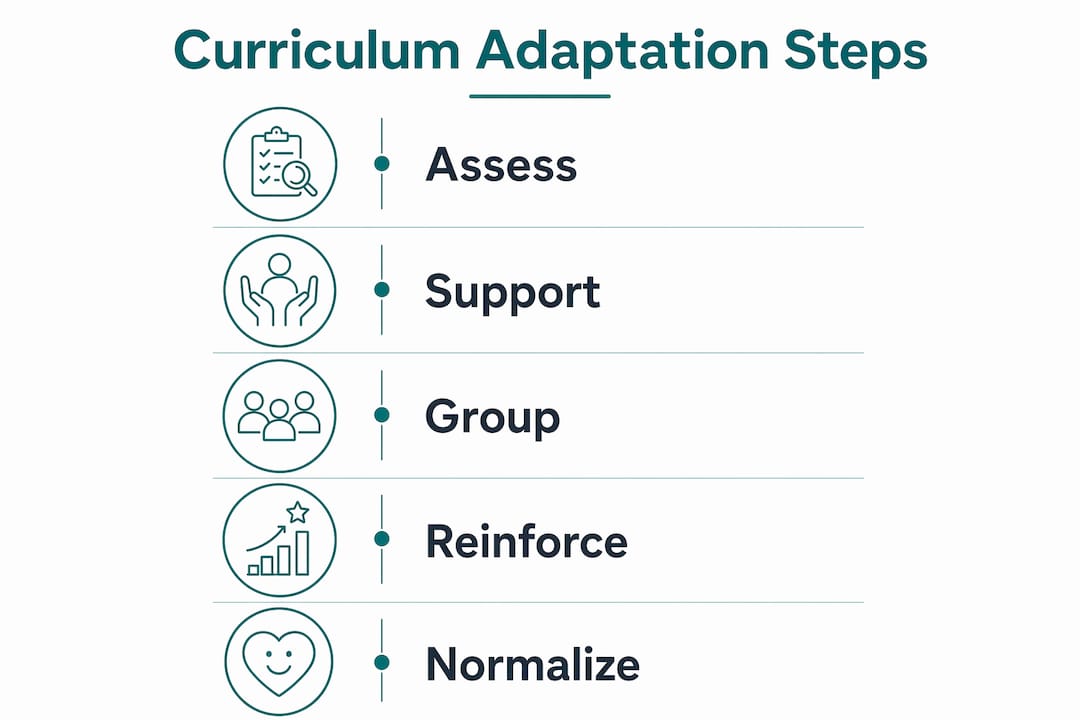
Schools carry most of the adaptation work, but parents play a meaningful role in reinforcing the process at home. The transition to a new curriculum is also an emotional experience for children, and how parents respond shapes how confidently a child approaches the new environment.
The most effective home strategies work on two levels: academic reinforcement and emotional normalization. On the academic side, parents can use age-appropriate literacy apps, structured reading programs, and tools like Khan Academy to fill specific subject gaps identified by the school. For older children in the 8 to 12 age range, online tutoring platforms can provide targeted support in math or writing that aligns with the new curriculum’s expectations.
Sudden shifts in teaching style cause anxiety, and parents can reduce this by familiarizing children with the new school environment before the first day. Reviewing the school’s syllabus together, watching virtual tour videos, and discussing what will be different and what will stay the same gives children a mental map of what to expect. This preparation is not about eliminating challenge. It is about replacing fear of the unknown with curiosity about something new.
Maintaining connections to a child’s home-country language and curriculum also matters, particularly for families who plan to return. A Japanese child attending an English-medium school in Singapore benefits from continued Japanese reading practice at home, even informally. This preserves literacy skills that would otherwise erode during the expat years.
Pro Tip: Schedule a brief weekly check-in with your child about one thing they found confusing and one thing they enjoyed at school. This habit surfaces academic gaps early and keeps communication open before small struggles become big ones.
Incorporating local cultural experiences, such as visits to the National Museum of Singapore, Gardens by the Bay, or neighborhood markets, gives children real-world anchors for what they are learning in class. Local experiences aligned with school content strengthen both academic engagement and cultural belonging simultaneously.
What logistical planning does successful curriculum adaptation require?
The practical side of curriculum adaptation begins before you land in Singapore. Families who start researching schools and curricula early, ideally six to twelve months before relocation, have significantly more options and less stress than those who begin after arrival.
International school fees in Asia range from approximately $4,000 to over $40,000 annually. This wide range reflects differences in school size, facilities, curriculum type, and support services. Budgeting for the right school over a three to five year posting is a financial planning decision, not just an educational one.
Key logistical factors to address before committing to a school:
Waitlists and availability. Popular international schools in Singapore, particularly those offering IB programs, often have waitlists of six months to a year. Applying early is not optional for families with specific curriculum requirements.
Age cut-offs and year-level alignment. Different curricula use different age cut-offs for year-level entry. A child who is in Year 3 under the British system may not map directly onto Grade 3 in an American school. Verify this with each school before assuming placement.
Curriculum continuity across years. If your child will transition from preschool to primary school during your posting, check that both schools share a compatible curriculum philosophy. A preschool using play-based learning that feeds into a rigid academic primary program creates a jarring transition.
Support services and class size. Smaller schools with lower student-to-teacher ratios provide more individualized adaptation support. A school with 15 students per class can respond to a new child’s needs far more quickly than one with 30.
Choosing schools based solely on reputation or convenience causes misalignment with long-term educational goals. Experts consistently advise ranking your family’s specific priorities, including re-entry plans, university targets, and language needs, before visiting schools. A school’s brand name matters far less than its curriculum fit for your child’s specific trajectory. You can explore a detailed curriculum selection guide to work through these priorities systematically.
Key takeaways
Adapting curriculum for expat children requires early planning, placement-based support, and alignment between school choice and long-term academic goals.
Point | Details |
Curriculum fit affects university pathways | Choosing the wrong curriculum can disrupt re-entry and university eligibility for 5 to 10 years. |
Math and literacy need priority protection | Gaps in sequential subjects compound quickly; target these areas first when switching curricula. |
Placement testing is non-negotiable | Accurate ability-based placement prevents both under-challenge and overwhelm in new school environments. |
Early logistical planning opens more options | Researching schools 6 to 12 months before relocation secures waitlist spots and better curriculum alignment. |
Home support reinforces school adaptation | Weekly academic check-ins and local cultural experiences accelerate both academic and emotional adjustment. |
What I’ve learned from watching families navigate curriculum transitions
I have seen families make every version of this decision, and the pattern that stands out most is this: the families who struggle most are not the ones who chose the “wrong” curriculum. They are the ones who chose without a framework.
A parent who picks a school because it has a beautiful campus and a well-known name, without asking how the school handles incoming students with different academic backgrounds, is setting their child up for a difficult first year. The child is not the problem. The mismatch is.
What I find genuinely encouraging is how much a small school with a thoughtful team can do when they actually know each child. The best learning happens when every child is truly seen and supported, and that is not a slogan. It is a structural reality in schools where teachers have the time and class sizes that allow for it. A teacher with 12 students notices a child struggling with phonics in week two. A teacher with 28 students may not notice until week eight.
My honest advice to every expat parent reading this: visit the school and ask the teachers what they do in the first month with a new student. Their answer will tell you everything. If they describe a specific process, with assessments, check-ins, and a named support person, trust that school. If they describe a general welcome and point to their website, keep looking.
Cultural integration deserves equal weight alongside academic continuity. A child who is academically on track but feels like an outsider will not perform to their potential. Schools that weave local culture into their curriculum, and that celebrate the diversity of their student body, give expat children something that no tutoring program can replicate: a sense of belonging.
— Elena
How Astor supports expat families with curriculum adaptation in Singapore
Astor International School in Singapore’s Tanglin area was built for exactly the families this article describes. As a small school with small class sizes, Astor has been recognized as both the best small school and the best affordable international school in Singapore. The International Primary Curriculum at Astor is designed to be adaptable by nature, making it one of the most effective frameworks for children arriving from diverse academic backgrounds. For younger children aged 1.5 and up, Astor’s preschool in Holland offers a nurturing environment that blends outdoor and classroom learning across two playgrounds. Families can explore Astor’s full curriculum or contact the admissions team directly to discuss how the school can support your child’s specific transition needs.
FAQ
Why is curriculum adaptation important for expat children?
Curriculum adaptation maintains academic continuity and prevents learning gaps when children move between different education systems. Without it, children can fall behind in sequential subjects like math and literacy, which are harder to remediate than non-core subjects.
What should I look for in a school’s curriculum adaptation process?
Look for schools that use placement assessments, offer EAL support, and group students by ability rather than age alone. A clear, specific intake process for new students is the strongest indicator that a school takes adaptation seriously.
Which curriculum is best for expat families in Singapore?
The IB Primary Years Program is widely preferred by frequently relocating families because of its portability across international schools globally. Families planning to return to a specific country, such as Japan or the UK, often prioritize national curriculum schools to preserve re-entry eligibility.
How early should I start planning my child’s school transition?
Start researching schools six to twelve months before your relocation date. Popular international schools in Singapore have waitlists, and early applications give you access to schools with the strongest curriculum alignment for your child’s needs.
How can I support my child’s curriculum transition at home?
Maintain regular academic check-ins, use targeted learning tools for identified gaps, and incorporate local cultural experiences that connect to school content. Preserving your child’s home-country language through informal reading also protects literacy skills during the transition period.
Recommended
Comments