


How teachers shape small class learning in Singapore
Many parents in Singapore assume that enrolling their child in a small class automatically guarantees more personalized teaching and deeper engagement. It is a reasonable assumption, but it is not entirely accurate. The truth is that class size creates the conditions for better learning, while the teacher is the one who actually delivers it. For families exploring school options for children aged 5 to 12, understanding this distinction can be the difference between choosing a school based on numbers alone versus finding one where your child will truly flourish. This article breaks down exactly how teachers operate differently in small class settings and why their approach matters most.
Table of Contents
Key Takeaways
Point | Details |
Teacher role is pivotal | The teacher’s approach, training, and engagement determine the real impact of small class environments. |
Small class benefits require expertise | Active facilitation and feedback only happen with trained teachers, not simply from having fewer students. |
Singapore context matters | Public schools may use larger classes but achieve personalized learning through flexible deployment and quality teaching. |
Ask beyond numbers | Parents should look for evidence of teacher engagement, student-centered strategies, and real interaction, not just class size statistics. |
Understanding small class environments in Singapore
Before we can talk about what teachers do differently, it helps to understand what “small class” actually means in the Singapore context. Class sizes vary significantly depending on the type of school. According to Singapore’s Ministry of Education, public primary schools average 30 to 40 students per class, with Primary 1 and Primary 2 classes slightly smaller at around 30 pupils. The national pupil-to-teacher ratio (PTR) sits at approximately 15:1 at the primary level, though this number can be misleading. Teachers are often deployed flexibly to support smaller group work despite the larger form classes.
Private and international schools, on the other hand, tend to offer significantly smaller classes, often between 15 and 25 students. This is one of the key draws for parents exploring alternatives to the mainstream system. When you are looking at the benefits of small class sizes for children aged 5 to 12, the setting truly matters.
Here is a quick comparison of typical class environments in Singapore:
School type | Average class size | PTR (approx.) | Typical age group |
Public primary school | 30 to 40 | 15:1 | 7 to 12 |
Private school | 20 to 25 | 10:1 to 12:1 | 5 to 12 |
International school | 15 to 22 | 8:1 to 12:1 | 5 to 12 |
Preschool (private) | 10 to 20 | Varies | 18 months to 6 |
Research also highlights where small classes make the biggest difference. Small classes excel particularly for younger pupils in the 5 to 12 age range, students who need additional support, and subjects that depend on discussion, hands-on exploration, and regular feedback. The returns do diminish without skilled teaching, which brings us to the heart of the matter.
Key scenarios where small class sizes provide the most value include:
Children in the early primary years who are building foundational literacy and numeracy
Learners who benefit from frequent one-on-one check-ins and reassurance
Subjects like creative writing, science inquiry, and spoken communication
Students transitioning to a new school environment or learning in a second language
Exploring the small international schools benefits further reinforces why the environment and the educator must work together.
Now that you see why small class sizes are a hot topic, let’s clarify what makes the teacher’s role different in these settings.
How teachers operate in small classes: More than instruction
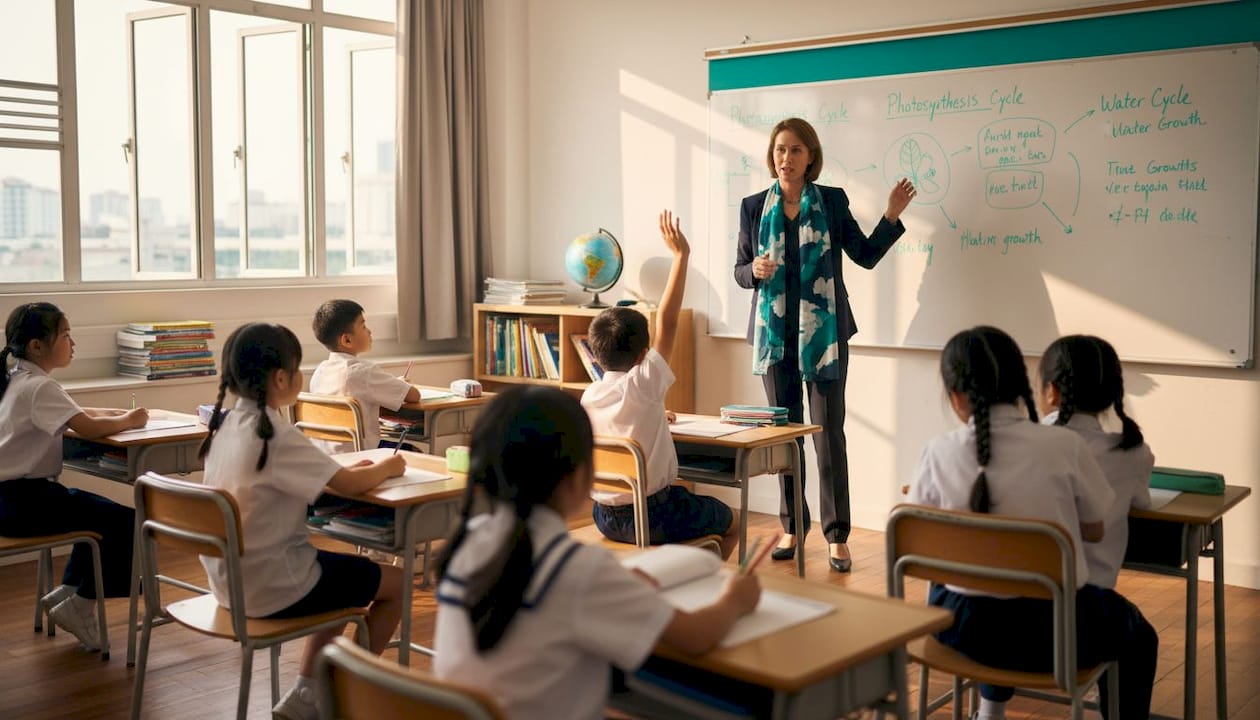
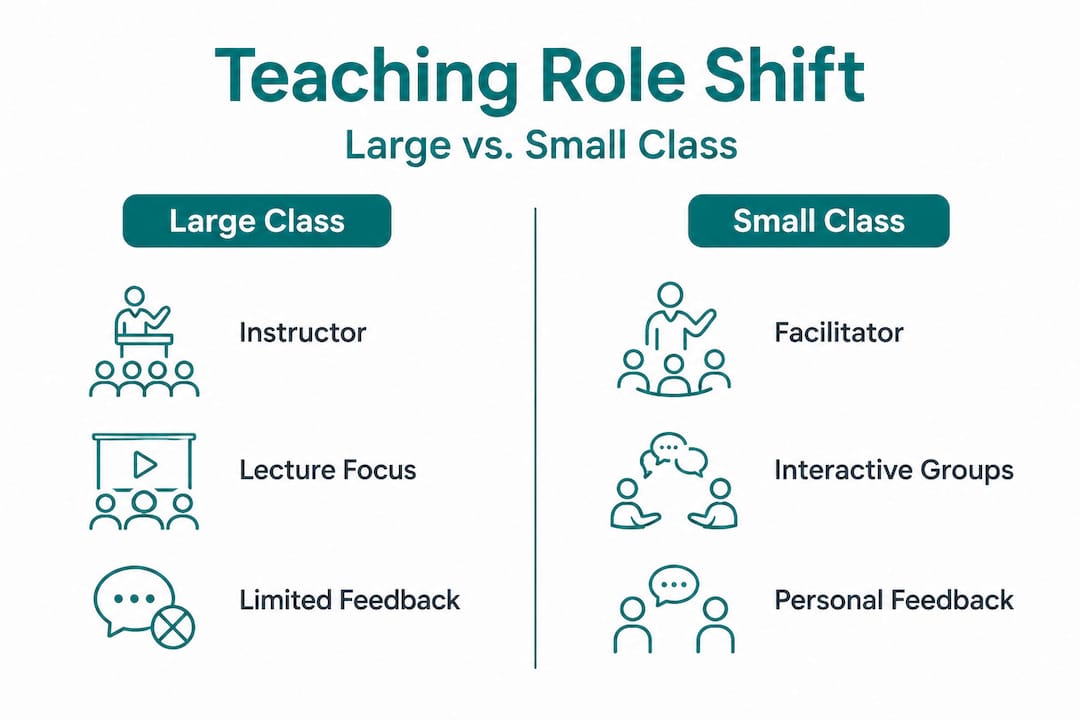
In a traditional large classroom, the teacher’s primary job is to deliver content clearly and efficiently to as many students as possible at once. There is simply not enough time or space to personalize the experience for each child. Small classes change that dynamic entirely. According to KnowledgeWorks, teachers in small classes shift from whole-class lecturing to facilitators of personalized learning, providing individualized attention, immediate feedback, and tailored instruction that responds to each student’s needs.
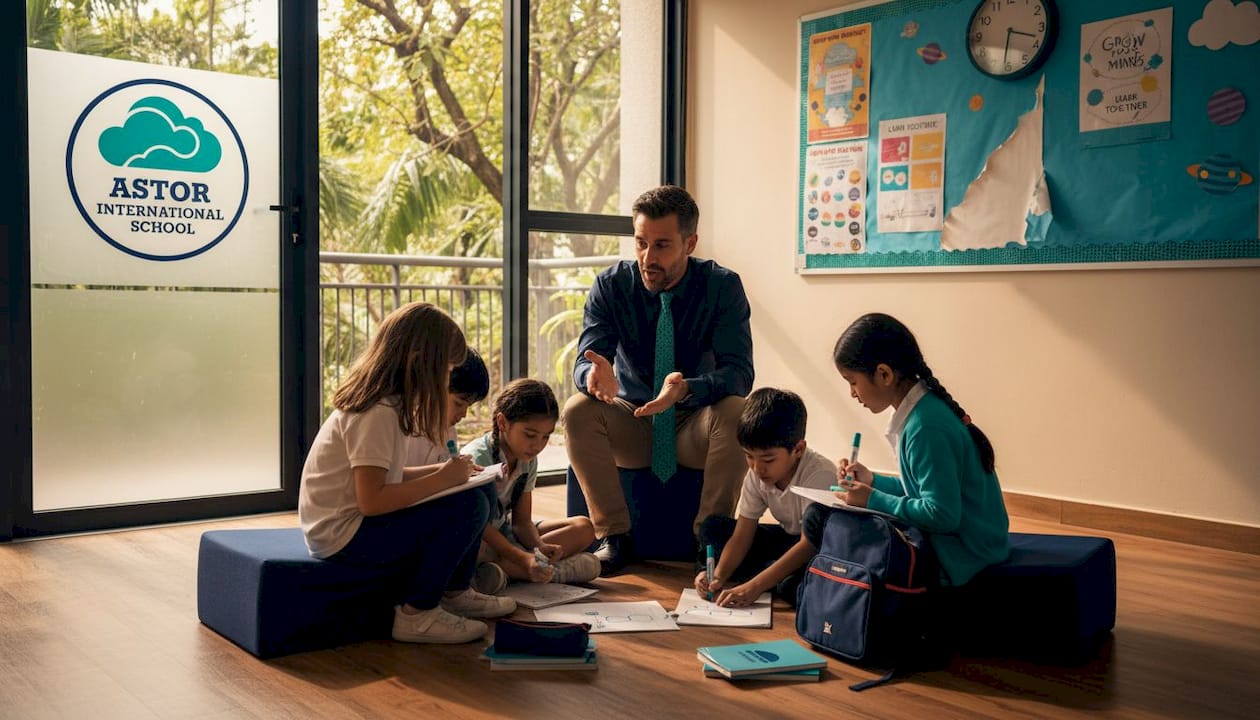
This is not just a subtle shift. It is a fundamentally different way of teaching. In a small class, your child’s teacher is moving between groups, listening carefully to individual responses, identifying misconceptions in real time, and adjusting the pace of instruction accordingly. The classroom becomes a dynamic, student-centered learning environment rather than a one-way broadcast.
Here is how the two models compare:
Teaching approach | Traditional large class | Small class facilitation |
Primary role | Information deliverer | Learning facilitator and mentor |
Student interaction | Mostly whole-group | Frequent individual and small-group |
Feedback timing | Delayed (written, after class) | Immediate and in-the-moment |
Lesson adaptation | Fixed pace for the majority | Adjusted for each child’s progress |
Relationship depth | Limited by scale | Deep, meaningful, and personal |
The teacher’s evolving role as a small schools stronger start anchor is one of the most compelling reasons families choose smaller settings. In practice, this looks like a teacher noticing that one child is struggling with a reading concept and pausing to work through it quietly together, while the rest of the group continues an activity independently. It looks like a teacher remembering that a particular student thrives when given a visual prompt first, so they prepare materials accordingly. These moments of responsiveness are only possible when the teacher can actually see and respond to every child in the room.
The teacher role evolves to facilitator through active methodologies like small group instruction, structured discussion, and targeted feedback loops. This is the essence of what makes small class teaching so powerful when done well.
Pro Tip: When visiting a school, ask how teachers are trained in small group facilitation. A school that invests in this specific professional development is far more likely to deliver genuine personalized learning, not just smaller rooms with the same old approach.
With this deeper look at the teacher’s evolving responsibilities, let’s examine how their expertise and training amplify these benefits.
Why teacher expertise matters more than class size
Here is something many school guides gloss over. Class size reduction alone does not automatically improve your child’s learning outcomes. The evidence is clear on this point. As noted by MOE and cited by education researchers including John Hattie and the Education Endowment Foundation, benefits depend on teacher training to leverage small sizes for meaningful feedback and differentiation. Without that training, a smaller room is just a smaller room.
This is why Singapore’s MOE has historically prioritized teacher quality over broad class size reduction. The cost of reducing class sizes across an entire national system is enormous, and the returns are inconsistent unless teachers know how to harness the intimacy that smaller groups afford. Strong classroom learning strategies are what translate the potential of a small class into real progress for each child.
“The best learning happens when every child is truly seen and supported.” This principle only becomes real when the teacher in front of your child is trained, motivated, and given the space to practice it every single day.
So what should you actually look for or ask about when evaluating a school? Here is a practical checklist:
Ask about professional development. How often do teachers receive training, and is any of it focused on small group instruction or differentiated teaching methods?
Inquire about teacher retention. High staff turnover disrupts the deep relationships that make small class settings so effective. Look for schools where teachers stay and grow.
Request to see a lesson in action. A skilled teacher in a small class should be moving, observing, questioning, and adapting, not simply standing at the front.
Ask how learning gaps are identified. Schools with strong pedagogical culture will have clear systems for tracking each child’s progress and responding quickly.
Find out how teachers communicate with parents. Frequent, personalized updates are a sign that the school truly knows your child as an individual.
Strong support at home also plays a role, and you can explore practical ideas for supporting your child’s learning alongside what the school provides. Some schools also use mixed-age group teaching to further personalize the learning experience, pairing children of different ages to build mentorship skills alongside academic growth.
Understanding expertise brings us to what all this means for your child’s day-to-day learning.
The impact on your child: Engagement, confidence, and growth
So what does all of this actually feel like for a 7-year-old or a 10-year-old sitting in that classroom? The differences are tangible and meaningful. In a well-run small class setting with a skilled teacher, children experience a fundamentally different kind of school day.
Research and educator experience in Singapore confirm that small classes in private schools enable high teacher engagement and personalization that is particularly beneficial for children aged 5 to 12. This is the age when children are forming their identity as learners. How they experience school during these years shapes their confidence, curiosity, and willingness to take on challenges for years to come.
Here is what changes in your child’s day-to-day experience:
More chances to speak and be heard. In a smaller group, every child gets real airtime during discussions. They are not lost in a sea of hands.
Faster identification of learning gaps. Teachers notice when a child is confused, and they respond quickly rather than letting misunderstandings compound over weeks.
Stronger sense of belonging. Children feel recognized as individuals, not just one of thirty. This builds emotional safety, which is the foundation of genuine learning.
Greater academic risk-taking. When children trust their teacher and feel known, they are more willing to try hard things, make mistakes, and ask questions.
Personalized encouragement. A teacher who knows your child’s strengths and struggles can offer praise and challenge that actually fits, not generic motivation.
Families who have explored what it means to be at the best small school in Singapore often describe the moment their child came home talking about school differently. More excited. More engaged. More themselves. That shift usually comes not from the size of the room, but from the quality of the relationship inside it. For families considering the investment carefully, discovering what an affordable international school Singapore can genuinely offer is worth exploring deeply.
Pro Tip: During any school visit, watch how the teacher responds when a child gives a wrong answer. A skilled small class teacher uses that moment as a learning opportunity, not a correction. That response tells you everything about the culture of the classroom.
Now, let’s step back and share a candid perspective that few articles address.
Our view: What most guides miss about teacher impact
Most articles on small class sizes focus heavily on numbers. They compare PTRs, cite research averages, and conclude that smaller is better. And while the data is real, this framing misses something essential. Numbers describe the container. Teachers fill it with meaning.
We have seen firsthand what happens when a class of 18 students has a teacher who is disengaged or untrained in facilitation. The smaller room does not save the experience. And we have also seen teachers work transformative magic with a group of 22 curious, energetic 8-year-olds because they knew every child by name, by learning style, and by the small things that light them up. That is not a numbers game. That is craft.
The advice we would offer any parent searching for the right school is this: stop counting students and start watching teachers. Visit the school. Sit in on a lesson if you can. Observe whether the teacher moves around the room or stands still. Listen for whether they ask open questions or closed ones. Notice whether children look comfortable making mistakes. These observations reveal far more than any brochure statistic.
At the heart of a student-centered classroom is a teacher who has been trained and supported to genuinely see each child. That is the standard worth holding schools to. When you find a school where teachers are given the time, tools, and training to truly know each student, you have found something rare and genuinely valuable.
Explore schools where teachers make a difference
If this article has helped you think differently about what to look for in a school, you are already asking better questions than most.
At Astor International School in the Tanglin area of Singapore, small class sizes are just the beginning. Awarded best small school in Singapore and recognized as the best affordable international school in Singapore, Astor pairs intimate learning environments with teachers who are trained and passionate about personalized education for children aged 5 to 12. You can explore the IPC curriculum that drives inquiry-based, hands-on learning, or take a broader look at learning at Astor to see how every element of the school day is designed around your child’s growth. Families are warmly welcome to visit and see the difference a truly engaged teacher makes. Discover more about Astor’s curriculum and take the next step toward finding the right fit for your child.
Frequently asked questions
What is considered a small class size for primary students in Singapore?
A small class typically refers to groups of 20 or fewer students in private or international school settings. According to Singapore’s MOE, public primary schools average closer to 30 students for P1 and P2, and up to 40 in higher primary levels.
Is teacher quality more important than class size in Singapore schools?
Yes, teacher training and engagement are decisive. Research confirms that the benefits of smaller classes depend on teachers being specifically trained to use that intimacy for differentiation, feedback, and personalized learning.
Will my child get more attention from teachers in a small class?
Yes, significantly more. In small class settings, teachers provide individualized attention and immediate, tailored feedback that simply is not possible when managing 35 or more students at once.
Do all Singapore schools offer small class sizes?
No. Most public schools in Singapore operate with larger classes but manage this through flexible teacher deployment and strong teaching quality. Genuinely small classes are far more common in private and international schools, where lower enrollment naturally supports smaller group sizes.
How can parents assess teacher quality in small class settings?
Observe how teachers respond during actual lessons, especially when children make mistakes or ask unexpected questions. Ask schools directly about their teacher training programs and look for active facilitation, movement, questioning, and genuine engagement rather than a teacher simply standing at the front of a smaller room.
Recommended

Comments